


HID in TYC setup. With no projector conversion. Video on pg 17.


Technical Assistant
iTrader: (5)
Joined: Oct 2006
Posts: 763
Likes: 0
From: Philadelphia, PA
Rep Power: 267 

Re: HID in TYC setup. With no projector conversion
To put it into terms that EVERYONE can understand. Putting an HID kit into our stock housings is like trying to put an STi wing on our trunk. Sure it wil work, but its gona look hella stupid.

Joined: Aug 2006
Posts: 2,978
Likes: 4
From: Charlotte
Rep Power: 292 
I like my commute
iTrader: (1)
Joined: Apr 2006
Posts: 3,237
Likes: 0
From: New Hampshire
Rep Power: 279 Re: HID in TYC setup. With no projector conversion
^errrr is that true? it depends what state you're in doesn't it..
Last edited by Kevbotron; Dec 11, 2007 at 05:31 PM.

Joined: Sep 2002
Posts: 51,241
Likes: 20
From: NV
Rep Power: 813 Re: HID in TYC setup. With no projector conversion
its illegal in every state. if car did not come with factory hid, it is illegal to add it. even retrofit, but its not as obvious.
Joined: Aug 2006
Posts: 2,978
Likes: 4
From: Charlotte
Rep Power: 292 Re: HID in TYC setup. With no projector conversion
here's one for example:
http://www.dot.gov/affairs/nhtsa4304.htm
there's many more out there if you search. but that's NHTSA. that's national. not any state, so that means all states.
http://www.dot.gov/affairs/nhtsa4304.htm
there's many more out there if you search. but that's NHTSA. that's national. not any state, so that means all states.
Joined: Aug 2006
Posts: 2,978
Likes: 4
From: Charlotte
Rep Power: 292 Re: HID in TYC setup. With no projector conversion
in the end, would it hold up in court, probably not. but with a D2S projector, my light is precisely aimed on the road and I don't have a bunch of glare blinding oncoming drivers and attracting attention from the cops because of the glare or some retarded blue or purple light color.
my retro may not be legal, but it's passed the North Carolina Safety Equipment Inspections twice with flying colors. to look at it up close or while driving, it looks stock and performs like a stock OEM projector. that's what is safe and what looks good.
(and no, gearbox, this post wasn't directed at you. i know you know the rules and what's good or not
 )
) I like my commute
iTrader: (1)
Joined: Apr 2006
Posts: 3,237
Likes: 0
From: New Hampshire
Rep Power: 279 Re: HID in TYC setup. With no projector conversion
ahhh this sucks I need to get my car inspected and I just installed the PNP kit argh... 
thanks for the heads up fellas
thanks for the heads up fellas

Registered!!
iTrader: (11)
Joined: Nov 2003
Posts: 4,576
Likes: 0
From: Lakewood, 562
Rep Power: 321 Re: HID in TYC setup. With no projector conversion
some of the best projectors for hid... if you have no clue about retrofitting and want a good job, and have around $1k to spend sometime, head over to www.retro-solutions.com they do great work.
single xenon e46 $99
matsushita ballasts $150
harness $60
hid bulbs $100
miscellous materials $40
total = $449
spare set of head lights $60-150
with spare head lights $509-599
if you dont do the reto yourself add about another $250 for labor.

Banished to the Depths of Rice.
iTrader: (3)
Joined: Jun 2005
Posts: 9,196
Likes: 1
From: SoCal 714/909/626
Rep Power: 353 Re: HID in TYC setup. With no projector conversion
most people charge 250-xxxx
so a basic retro about 850 (bare minimal)
however, the more skilled retrofitters are gonna charge more because of the skill and percision....
i charge 350+ for my retrofits because my projectors not only can move up and down, but they can rotate up to quite a few degrees, meaning? a perfect stright cut off line...every time.
and if u know or heard of a retro god by the name of larry, he charges XXX to to XXXX for retros.
so a basic retro about 850 (bare minimal)
however, the more skilled retrofitters are gonna charge more because of the skill and percision....
i charge 350+ for my retrofits because my projectors not only can move up and down, but they can rotate up to quite a few degrees, meaning? a perfect stright cut off line...every time.
and if u know or heard of a retro god by the name of larry, he charges XXX to to XXXX for retros.

Registered!!
Joined: Oct 2007
Posts: 107
Likes: 0
From: Atlanta, GA
Rep Power: 229 Re: HID in TYC setup. With no projector conversion
I got an e-bay 8000k HID kit for $75 shipped; it was fastastic. Then both bulbs started flickering now and then. Then one or the other would go out. If I cycled the power, they would usually restart. So they work, but not as reliably as I wanted.
The whole point of the HID kit is to:
a) Make me feel all cool 'n stuh
b) Have more light output...percieved anyway.
For B, before anyone goes bonkers about the lumen measurements for HID bulbs at various wavelengths, the overall reason they appear brighter is more total area under the wavelength vs. intensity curve. Yes, the human eye is most sensitive to yellow-ish light, so halogen's give the best contrast at night by default.
For A, HID's are just plain gangster. Until one of them goes out when you are telling someone else how cool they are. In light of the situation, I wanted to keep it from happening. I knew it was some sort of BS electrical problem, because the bulbs would always restart.
I put an old 1F cap in parallel with the bulb +DC rails. While I experienced less overall flickering, arc extinguishment, etc... today I decided that it did not fix the problem. So I started researching all over the place and found this... (we're concerned with part 4)
A. Characterization of HID Lamps
A brief characterization of HID lamps (HPS and MH lamps) and the related ballast requirements are summarized in the following points.
1. Ignition. HID lamps need an appropriate voltage across the electrodes to initiate and mantain glow discharge. Furthermore the ballast should provide sufficient current at glow discharge voltage(appr. 90V for HPS and 180V for MH) forcing the glow-to-arc transition. Therefore, the ballast should provide increased open circuit voltage (>600V) for MH(Type I, 2+1 electrodes) lamps and high voltage pulses (2000 - 3000V, 1µs) for MH (Type II, 2 electrodes) and HPS(2 electrodes) lamps.
2. Warm up time. The warm up time for HID lamps is several minutes (shorter for MH and longer for HPS lamps). In this period the resistance of the lamp (measured by applying square wave current) continuously increases from a low value [6W (400W, MH)] to an essentially higher nominal value [40W (400W, MH)]. Therefore, the ballast should act as a nearly constant current source providing sufficient increasing (nearly linear) power for the lamp.
3. Lamp Voltage Rise. HPS lamps in particular, have an excessive rise in lamp voltage during their life time. This voltage rise can achieve approximately one hundred seventy percent (170%) of the one hundred hour operation value. Therefore, a ballast should keep the lamp power within an acceptable power range derived from the ballast curve.
4. I-V Characteristics. If the lamp current is forced to change with a certain value (DI) the lamps can respond in two different ways as it is shown in Fig 1.
 If the current is changed slowly, (i.e. within a minute), and with a certain value (DI) the lamp voltage changes only with a small value . In this case the lamp acts like a non-ideal bidirectional Zener diode. Furthermore, if the change is fast (< 1s) a decreased lamp voltage is produced by the increased lamp current and vice versa.Therefore, if a lamp is connected directly to a voltage source, a highly unstable state can be resulted. Any small current fluctuation can cause extinction or a very fast current increase, which can damage the lamp resulting a practically short circuited voltage source. Evidently, a ballast should act as a current source allowing the lamp to determine its voltage.
5. Acoustic Resonance. At high frequency (f > 4 kHz) operation of HID lamps, standing pressure waves (acoustic resonances) can occur in the discharge tube. This phenomenon may lead to visible arc distortions, resulting in decreased lamp life time and, in some cases, cracking of the discharge tubes. Acoustic resonances are driven by periodic instantaneous lamp power. In conclusion it may be stated that the occurrence of acoustic resonances at high frequency can be considered as a limitation factor for a wide and reliable application of high frequency (< 60kHz) electronic ballasts supplying HID lamps.
6. Cataphoretic phenomenon.Cataphoretic effects may result when a lamp is operated with DC current. Such operation results in demixing of the gas-filling as the sodium is transported toward the cathode side of the tube, making the lamp inadequate for lighting purposes. Therefore, the polarity of the lamp current should be periodically changed by the ballast (i.e. every 10 ms) providing an axially homogeneous discharge. An approximately zero DC component is recommended. Obviously the situation is different for special HID lamps designed for DC operation.
So basically, if your DC Bus volts or current changes at all, as long as it does so slowly, the bulbs will be just fine. However, I have noticed the following events usually result in a bulb going out on one side or the other:
1) Motor RPM > 4000 on slight to major incline (high load)...I think the ignition system is compensating spark voltage proportional to manifold vac; more spark means more current, more current draw means sys DC bus volts goes down; ballast has less volts, so it sends out more amps to compensate, bulb resistance goes up as current goes up, eventually bulb resistance is so high that it goes out. I guess this all happens muy rapido.
2) Sharp right turns. I thought this was a grounding issue somewhere, so used nearly 2 full rolls of electrical tape re-wrapping all the wires, esp. the fuse/fusebox gizmo & the ignition-discharge wire. Turns out this has nothing to do with my problem...I kept a log and found out that for some reason, ~70% of the turns I make in life are right.
So whats the point of all this? Well, if I can keep the current and voltage going to the BALLAST as constant as possible over the period of 1 sec, then my bulbs should not go out.
It seems that the ballast is TRYING to compensate for the sudden voltage drop, and it CAN pull enough amps to do so, but the tiny *** factory wiring is dissipating so much of the current its trying to pull as heat. So, it either catches your car on fire, or the bulb goes out. Luckily, only the latter has happened to me. So, with an upgraded gauge (10-12 should be enough overkill) DC power and ground wire running to the ballast via an automotive relay, this should solve most of the world's HID problems. I checked them out at Radioshack; you can get a 30A automotive DC relay for around $6 bucks. They usually sell crazybig wire too.
So, I recommend that everyone who gets one of these kits to have them wired to their battery via a switchable relay.
PS, if anyone wants a pic of the circuit let me know. When it comes to electricity, asking questions is much better than catching on fire.
The whole point of the HID kit is to:
a) Make me feel all cool 'n stuh
b) Have more light output...percieved anyway.
For B, before anyone goes bonkers about the lumen measurements for HID bulbs at various wavelengths, the overall reason they appear brighter is more total area under the wavelength vs. intensity curve. Yes, the human eye is most sensitive to yellow-ish light, so halogen's give the best contrast at night by default.
For A, HID's are just plain gangster. Until one of them goes out when you are telling someone else how cool they are. In light of the situation, I wanted to keep it from happening. I knew it was some sort of BS electrical problem, because the bulbs would always restart.
I put an old 1F cap in parallel with the bulb +DC rails. While I experienced less overall flickering, arc extinguishment, etc... today I decided that it did not fix the problem. So I started researching all over the place and found this... (we're concerned with part 4)
A. Characterization of HID Lamps
A brief characterization of HID lamps (HPS and MH lamps) and the related ballast requirements are summarized in the following points.
1. Ignition. HID lamps need an appropriate voltage across the electrodes to initiate and mantain glow discharge. Furthermore the ballast should provide sufficient current at glow discharge voltage(appr. 90V for HPS and 180V for MH) forcing the glow-to-arc transition. Therefore, the ballast should provide increased open circuit voltage (>600V) for MH(Type I, 2+1 electrodes) lamps and high voltage pulses (2000 - 3000V, 1µs) for MH (Type II, 2 electrodes) and HPS(2 electrodes) lamps.
2. Warm up time. The warm up time for HID lamps is several minutes (shorter for MH and longer for HPS lamps). In this period the resistance of the lamp (measured by applying square wave current) continuously increases from a low value [6W (400W, MH)] to an essentially higher nominal value [40W (400W, MH)]. Therefore, the ballast should act as a nearly constant current source providing sufficient increasing (nearly linear) power for the lamp.
3. Lamp Voltage Rise. HPS lamps in particular, have an excessive rise in lamp voltage during their life time. This voltage rise can achieve approximately one hundred seventy percent (170%) of the one hundred hour operation value. Therefore, a ballast should keep the lamp power within an acceptable power range derived from the ballast curve.
4. I-V Characteristics. If the lamp current is forced to change with a certain value (DI) the lamps can respond in two different ways as it is shown in Fig 1.
If the current is changed slowly, (i.e. within a minute), and with a certain value (DI) the lamp voltage changes only with a small value . In this case the lamp acts like a non-ideal bidirectional Zener diode. Furthermore, if the change is fast (< 1s) a decreased lamp voltage is produced by the increased lamp current and vice versa.Therefore, if a lamp is connected directly to a voltage source, a highly unstable state can be resulted. Any small current fluctuation can cause extinction or a very fast current increase, which can damage the lamp resulting a practically short circuited voltage source. Evidently, a ballast should act as a current source allowing the lamp to determine its voltage.5. Acoustic Resonance. At high frequency (f > 4 kHz) operation of HID lamps, standing pressure waves (acoustic resonances) can occur in the discharge tube. This phenomenon may lead to visible arc distortions, resulting in decreased lamp life time and, in some cases, cracking of the discharge tubes. Acoustic resonances are driven by periodic instantaneous lamp power. In conclusion it may be stated that the occurrence of acoustic resonances at high frequency can be considered as a limitation factor for a wide and reliable application of high frequency (< 60kHz) electronic ballasts supplying HID lamps.
6. Cataphoretic phenomenon.Cataphoretic effects may result when a lamp is operated with DC current. Such operation results in demixing of the gas-filling as the sodium is transported toward the cathode side of the tube, making the lamp inadequate for lighting purposes. Therefore, the polarity of the lamp current should be periodically changed by the ballast (i.e. every 10 ms) providing an axially homogeneous discharge. An approximately zero DC component is recommended. Obviously the situation is different for special HID lamps designed for DC operation.
So basically, if your DC Bus volts or current changes at all, as long as it does so slowly, the bulbs will be just fine. However, I have noticed the following events usually result in a bulb going out on one side or the other:
1) Motor RPM > 4000 on slight to major incline (high load)...I think the ignition system is compensating spark voltage proportional to manifold vac; more spark means more current, more current draw means sys DC bus volts goes down; ballast has less volts, so it sends out more amps to compensate, bulb resistance goes up as current goes up, eventually bulb resistance is so high that it goes out. I guess this all happens muy rapido.
2) Sharp right turns. I thought this was a grounding issue somewhere, so used nearly 2 full rolls of electrical tape re-wrapping all the wires, esp. the fuse/fusebox gizmo & the ignition-discharge wire. Turns out this has nothing to do with my problem...I kept a log and found out that for some reason, ~70% of the turns I make in life are right.
So whats the point of all this? Well, if I can keep the current and voltage going to the BALLAST as constant as possible over the period of 1 sec, then my bulbs should not go out.
It seems that the ballast is TRYING to compensate for the sudden voltage drop, and it CAN pull enough amps to do so, but the tiny *** factory wiring is dissipating so much of the current its trying to pull as heat. So, it either catches your car on fire, or the bulb goes out. Luckily, only the latter has happened to me. So, with an upgraded gauge (10-12 should be enough overkill) DC power and ground wire running to the ballast via an automotive relay, this should solve most of the world's HID problems. I checked them out at Radioshack; you can get a 30A automotive DC relay for around $6 bucks. They usually sell crazybig wire too.
So, I recommend that everyone who gets one of these kits to have them wired to their battery via a switchable relay.
PS, if anyone wants a pic of the circuit let me know. When it comes to electricity, asking questions is much better than catching on fire.
Registered!!
Joined: Oct 2007
Posts: 107
Likes: 0
From: Atlanta, GA
Rep Power: 229 Re: HID in TYC setup. With no projector conversion
crap, btw the quote was from http://www.ballastdesign.com/overview.shtml. Good luck ere'body.
Joined: Aug 2006
Posts: 2,978
Likes: 4
From: Charlotte
Rep Power: 292 Re: HID in TYC setup. With no projector conversion
I got an e-bay 8000k HID kit for $75 shipped; it was fastastic. Then both bulbs started flickering now and then. Then one or the other would go out. If I cycled the power, they would usually restart. So they work, but not as reliably as I wanted.
The whole point of the HID kit is to:
a) Make me feel all cool 'n stuh
b) Have more light output...percieved anyway.
For B, before anyone goes bonkers about the lumen measurements for HID bulbs at various wavelengths, the overall reason they appear brighter is more total area under the wavelength vs. intensity curve. Yes, the human eye is most sensitive to yellow-ish light, so halogen's give the best contrast at night by default.
For A, HID's are just plain gangster. Until one of them goes out when you are telling someone else how cool they are. In light of the situation, I wanted to keep it from happening. I knew it was some sort of BS electrical problem, because the bulbs would always restart.
I put an old 1F cap in parallel with the bulb +DC rails. While I experienced less overall flickering, arc extinguishment, etc... today I decided that it did not fix the problem. So I started researching all over the place and found this... (we're concerned with part 4)
The whole point of the HID kit is to:
a) Make me feel all cool 'n stuh
b) Have more light output...percieved anyway.
For B, before anyone goes bonkers about the lumen measurements for HID bulbs at various wavelengths, the overall reason they appear brighter is more total area under the wavelength vs. intensity curve. Yes, the human eye is most sensitive to yellow-ish light, so halogen's give the best contrast at night by default.
For A, HID's are just plain gangster. Until one of them goes out when you are telling someone else how cool they are. In light of the situation, I wanted to keep it from happening. I knew it was some sort of BS electrical problem, because the bulbs would always restart.
I put an old 1F cap in parallel with the bulb +DC rails. While I experienced less overall flickering, arc extinguishment, etc... today I decided that it did not fix the problem. So I started researching all over the place and found this... (we're concerned with part 4)
A. I've never had one go out, so i can't relate to that, but the whole reason i put mine in was so that i could see better at night. i could care less what others think.
B. There's no "default" about it. HID's are far superior for night time driving, and yes, it has a ton to do with overall lumen output.
[COLOR=#cc6600]A. Characterization of HID Lamps
A brief characterization of HID lamps (HPS and MH lamps) and the related ballast
....................
So basically, if your DC Bus volts or current changes at all, as long as it does so slowly, the bulbs will be just fine.
A brief characterization of HID lamps (HPS and MH lamps) and the related ballast
....................
So basically, if your DC Bus volts or current changes at all, as long as it does so slowly, the bulbs will be just fine.
However, I have noticed the following events usually result in a bulb going out on one side or the other:
1) Motor RPM > 4000 on slight to major incline (high load)...I think the ignition system is compensating spark voltage proportional to manifold vac; more spark means more current, more current draw means sys DC bus volts goes down; ballast has less volts, so it sends out more amps to compensate, bulb resistance goes up as current goes up, eventually bulb resistance is so high that it goes out. I guess this all happens muy rapido.
2) Sharp right turns. I thought this was a grounding issue somewhere, so used nearly 2 full rolls of electrical tape re-wrapping all the wires, esp. the fuse/fusebox gizmo & the ignition-discharge wire. Turns out this has nothing to do with my problem...I kept a log and found out that for some reason, ~70% of the turns I make in life are right.
1) Motor RPM > 4000 on slight to major incline (high load)...I think the ignition system is compensating spark voltage proportional to manifold vac; more spark means more current, more current draw means sys DC bus volts goes down; ballast has less volts, so it sends out more amps to compensate, bulb resistance goes up as current goes up, eventually bulb resistance is so high that it goes out. I guess this all happens muy rapido.
2) Sharp right turns. I thought this was a grounding issue somewhere, so used nearly 2 full rolls of electrical tape re-wrapping all the wires, esp. the fuse/fusebox gizmo & the ignition-discharge wire. Turns out this has nothing to do with my problem...I kept a log and found out that for some reason, ~70% of the turns I make in life are right.
1. it's a rare granny-driving day that i shift below 4000 RPM's in first and second gear. that said, my HID's don't flicker at all, even when i hit the rev-limiter around 7200 RPM's (yes it happens a lot).
2. right turn, left turn, either way shouldn't matter. the fact that it does with you even further indicates you have a wiring problem. HID ballasts for cars are electronic and have built in protections. my guess is that something is moving/shifting when you turn and shorting out to ground. then when you stop, recycle power, it has shifted back to normal and that's why they work again.
So whats the point of all this? Well, if I can keep the current and voltage going to the BALLAST as constant as possible over the period of 1 sec, then my bulbs should not go out.
It seems that the ballast is TRYING to compensate for the sudden voltage drop, and it CAN pull enough amps to do so, but the tiny *** factory wiring is dissipating so much of the current its trying to pull as heat. So, it either catches your car on fire, or the bulb goes out. Luckily, only the latter has happened to me. So, with an upgraded gauge (10-12 should be enough overkill) DC power and ground wire running to the ballast via an automotive relay, this should solve most of the world's HID problems. I checked them out at Radioshack; you can get a 30A automotive DC relay for around $6 bucks. They usually sell crazybig wire too.
So, I recommend that everyone who gets one of these kits to have them wired to their battery via a switchable relay.
PS, if anyone wants a pic of the circuit let me know. When it comes to electricity, asking questions is much better than catching on fire.
It seems that the ballast is TRYING to compensate for the sudden voltage drop, and it CAN pull enough amps to do so, but the tiny *** factory wiring is dissipating so much of the current its trying to pull as heat. So, it either catches your car on fire, or the bulb goes out. Luckily, only the latter has happened to me. So, with an upgraded gauge (10-12 should be enough overkill) DC power and ground wire running to the ballast via an automotive relay, this should solve most of the world's HID problems. I checked them out at Radioshack; you can get a 30A automotive DC relay for around $6 bucks. They usually sell crazybig wire too.
So, I recommend that everyone who gets one of these kits to have them wired to their battery via a switchable relay.
PS, if anyone wants a pic of the circuit let me know. When it comes to electricity, asking questions is much better than catching on fire.
okay, so i don't design HID systems by trade, but i am an electrical engineer by trade. i've done several years of research into HID lighting. for starters, HID isn't just for cars. all of the following are HID (High Intensity Discharge)
HPS (High Pressure Sodium)
LPS (Low Pressure Sodium)
MV (Mercury Vapor)
MH (Metal Halide)
Xenon (technically a noble gas element, but coined as a type of bulb for automotive use)
as i said before, all of these use different ballast drastically different from each other. they are not interchangeable with any other. you can't run a HPS bulb on a MH ballast and so on. the wattage of each ballast is bulb specific as well. you can't run a 250w MH bulb on a 175w MH ballast. nor can you run 2-175w MH's on a 400w MH ballast. the xenon ballasts for our cars are designed for automotive use. they are specifically designed for varying supply voltages. you can come over, we'll put a meter on my car and drive around and i'll show you this. they are specifically designed to start up fast and reach operating brightness within a few seconds. other HID ballasts don't do this. it takes several minutes for MH ballasts to get the bulb to operating brightness and color. i ran MH lighting on several saltwater reef aquariums for years.
you have an electrical problem with your car, the info you posted doesn't really apply to automotive xenon ballasts, and HID's are still better for night time driving.
 that is all for now. (steps down off soapbox)
 Last edited by electric130; Dec 12, 2007 at 07:41 AM.
Registered!!
Joined: Oct 2007
Posts: 107
Likes: 0
From: Atlanta, GA
Rep Power: 229 Re: HID in TYC setup. With no projector conversion
Electric130, I agree with your recommendations. As far as the actual gas content of the various "xenon"-branded automotive HID systems, I was operating under the assumption that the xenon gas content was only present to facilitate "instant-on" lamp output; the other gas(es) in the bulb were similar to other, non-automotive HID bulbs like metal halide, high pressure sodium, etc...which is why the bulbs start out dim, then increase to full output. But again, these were assumptions, and without references, its all talk.
As far as having an electrical problem with my car, I agree. I'm thinking Honda's "Electrical Load Detector" voltage regulator is having a hard time predicting what the system load is.
As far as I know, the PCM has an input for the ELD, and a separate output for controlling the excitation of the alternator field windings. This would mean that the PCM is programmed with a "map" of field-winding currents for various system loads? So if the PCM is seeing loads it is not programmed to compensate for, then DC bus volts would always be low as a result.
All I want is my DC bus to stay as close to 14.4vdc as possible. If this means increased mechanical load on the motor, I expect the PCM to increase the motor idle to compensate.
I would really like to find an aftermarket ECU/PCM unit that would let me do all this, scale FI PWM for boost, and whatever else would be fun. Ive looked at Motec & some other brands; it looks interesting, aside from developing the initial fuel & timing maps.
Anyway, the topic is HID, and im on another planet. Ill quit rambling now and let everyone get back to business. It would be nice to have a thread or something here for all 7th gen engineering data...would save on late-night search time.
Thanks again for the info though, i'll be installing those relays asap & post results after I figure out whats up.
As far as having an electrical problem with my car, I agree. I'm thinking Honda's "Electrical Load Detector" voltage regulator is having a hard time predicting what the system load is.
As far as I know, the PCM has an input for the ELD, and a separate output for controlling the excitation of the alternator field windings. This would mean that the PCM is programmed with a "map" of field-winding currents for various system loads? So if the PCM is seeing loads it is not programmed to compensate for, then DC bus volts would always be low as a result.
All I want is my DC bus to stay as close to 14.4vdc as possible. If this means increased mechanical load on the motor, I expect the PCM to increase the motor idle to compensate.
I would really like to find an aftermarket ECU/PCM unit that would let me do all this, scale FI PWM for boost, and whatever else would be fun. Ive looked at Motec & some other brands; it looks interesting, aside from developing the initial fuel & timing maps.
Anyway, the topic is HID, and im on another planet. Ill quit rambling now and let everyone get back to business. It would be nice to have a thread or something here for all 7th gen engineering data...would save on late-night search time.
Thanks again for the info though, i'll be installing those relays asap & post results after I figure out whats up.
Joined: Aug 2006
Posts: 2,978
Likes: 4
From: Charlotte
Rep Power: 292 Re: HID in TYC setup. With no projector conversion
Electric130, I agree with your recommendations. As far as the actual gas content of the various "xenon"-branded automotive HID systems, I was operating under the assumption that the xenon gas content was only present to facilitate "instant-on" lamp output; the other gas(es) in the bulb were similar to other, non-automotive HID bulbs like metal halide, high pressure sodium, etc...which is why the bulbs start out dim, then increase to full output. But again, these were assumptions, and without references, its all talk.
As far as having an electrical problem with my car, I agree. I'm thinking Honda's "Electrical Load Detector" voltage regulator is having a hard time predicting what the system load is.
As far as I know, the PCM has an input for the ELD, and a separate output for controlling the excitation of the alternator field windings. This would mean that the PCM is programmed with a "map" of field-winding currents for various system loads? So if the PCM is seeing loads it is not programmed to compensate for, then DC bus volts would always be low as a result.
All I want is my DC bus to stay as close to 14.4vdc as possible. If this means increased mechanical load on the motor, I expect the PCM to increase the motor idle to compensate.
I would really like to find an aftermarket ECU/PCM unit that would let me do all this, scale FI PWM for boost, and whatever else would be fun. Ive looked at Motec & some other brands; it looks interesting, aside from developing the initial fuel & timing maps.
Anyway, the topic is HID, and im on another planet. Ill quit rambling now and let everyone get back to business. It would be nice to have a thread or something here for all 7th gen engineering data...would save on late-night search time.
Thanks again for the info though, i'll be installing those relays asap & post results after I figure out whats up.
As far as having an electrical problem with my car, I agree. I'm thinking Honda's "Electrical Load Detector" voltage regulator is having a hard time predicting what the system load is.
As far as I know, the PCM has an input for the ELD, and a separate output for controlling the excitation of the alternator field windings. This would mean that the PCM is programmed with a "map" of field-winding currents for various system loads? So if the PCM is seeing loads it is not programmed to compensate for, then DC bus volts would always be low as a result.
All I want is my DC bus to stay as close to 14.4vdc as possible. If this means increased mechanical load on the motor, I expect the PCM to increase the motor idle to compensate.
I would really like to find an aftermarket ECU/PCM unit that would let me do all this, scale FI PWM for boost, and whatever else would be fun. Ive looked at Motec & some other brands; it looks interesting, aside from developing the initial fuel & timing maps.
Anyway, the topic is HID, and im on another planet. Ill quit rambling now and let everyone get back to business. It would be nice to have a thread or something here for all 7th gen engineering data...would save on late-night search time.
Thanks again for the info though, i'll be installing those relays asap & post results after I figure out whats up.
oh, and for cheap electrical parts, go to www.partsexpress.com that's where i buy all my harness supplies (heat shrink, split loom tubing, relays, sockets, car audio connectors and wire, battery connectors, etc) they have just about everything and it's dirt cheap.
Joined: Sep 2002
Posts: 51,241
Likes: 20
From: NV
Rep Power: 813 Re: HID in TYC setup. With no projector conversion
our cars charging system is very weak. you can roll up two windows at a time and have the headlight dim very noticably. there just isnt enough power to run accessories and all the other car functions. im really glad the halogen zeta ballasts fixed this dimming cause it got so annoying after a while. the voltage frequently drops below 12v while driving and even lower depending on the accessories used. that means not only is the alt not producing enough power, it has to default to the battery and start using it as a backup so your car doesnt go dead.
Joined: Sep 2002
Posts: 51,241
Likes: 20
From: NV
Rep Power: 813 Re: HID in TYC setup. With no projector conversion
another good retrofit site is customlightz.com which is prolly the better choice considering they have done a bunch of large civic reflector retrofits that look nice.

Joined: Aug 2006
Posts: 2,978
Likes: 4
From: Charlotte
Rep Power: 292 Joined: Sep 2002
Posts: 51,241
Likes: 20
From: NV
Rep Power: 813 Re: HID in TYC setup. With no projector conversion
got any new pics of yours? those fogs are super bright from what i remember. ive been looking all over but cant find blazers anywhere. i was gonna try to do the retro with them and a yellow hid kit so i can actually drive with fogs on since white isnt allowed lol
Joined: Aug 2006
Posts: 2,978
Likes: 4
From: Charlotte
Rep Power: 292 Re: HID in TYC setup. With no projector conversion
and as far as finding the fogs, here you go:
http://cgi.ebay.com/ebaymotors/CLEAR...mZ230201847414
the bulb shown there is the 800 series bulb i was talking about before. the focal point of the 8xx HID PNP kits is pretty much identical to the filament position of the 8xx series halogens. so you get a perfect cutoff with tons of color. my cutoff is mainly purple, but the light is bright clear white.
that auction's $20 less than i paid for mine. i even have a second set brand new still laying around that i was going to put on my wife's old car, but then we sold it.
Last edited by electric130; Dec 12, 2007 at 01:38 PM.
Banished to the Depths of Rice.
iTrader: (3)
Joined: Jun 2005
Posts: 9,196
Likes: 1
From: SoCal 714/909/626
Rep Power: 353 Re: HID in TYC setup. With no projector conversion
like the diameter of the lense and the length of the whole projector?
Joined: Sep 2002
Posts: 51,241
Likes: 20
From: NV
Rep Power: 813 Re: HID in TYC setup. With no projector conversion
man those blazers take so well to hid. i was gonna get an h3c kit for my current fogs (regular h3 kit sucks, ive seen pics and theres no cutoff lol), but the vendor here told me they break too easily. so idk. i kinda like my fogs but would like something more useful. they are too efficient with no glare, so they make lousy drls, and at night the output is too bright on the ground. which i guess is how a good fog light should be but still lol. i have an extra pair and right now im on the lookout for a small yellow glass disc i can maybe install inside. the yellow bulbs suck, and painting the bowl really lost alot of light output altho the color was good. so maybe a small camera lens or something idk. lemme know if you have ideas 
Joined: Aug 2006
Posts: 2,978
Likes: 4
From: Charlotte
Rep Power: 292 Re: HID in TYC setup. With no projector conversion

Registered!!
iTrader: (16)
Joined: Jul 2003
Posts: 938
Likes: 0
From: S.F.V so.california
Rep Power: 0 Re: HID in TYC setup. With no projector conversion
Dont put 4300k into stock housing , its just gonna look like highbeams straight up , too white , more color = less visibility yes but its less blinding to other drivers , dont get those solid color blue & purple temps like 10k or 12k stick witha 6k or 8k and adjust ur headlights slightly lower and our stock housing with HID is still less blinding than a escalade ,older acura tl, is300 using those reflector headlights with HID
Joined: Aug 2006
Posts: 2,978
Likes: 4
From: Charlotte
Rep Power: 292 Re: HID in TYC setup. With no projector conversion
Dont put 4300k into stock housing , its just gonna look like highbeams straight up , too white , more color = less visibility yes but its less blinding to other drivers , dont get those solid color blue & purple temps like 10k or 12k stick witha 6k or 8k and adjust ur headlights slightly lower and our stock housing with HID is still less blinding than a escalade ,older acura tl, is300 using those reflector headlights with HID
Joined: Sep 2002
Posts: 51,241
Likes: 20
From: NV
Rep Power: 813 Re: HID in TYC setup. With no projector conversion
he has a point i guess, if you have to have a kit, at least the 8000k will only be as bright as a halogen, where the 4300k will be much brighter and cause more glare. but like you said, even with 8000k it will be more glare than a stock halogen setup.
heres a pic of my old glare, i never did get flashed, but i felt bad for traffic and eventually took it off. its the 4300k in oem housings.
stock halogen glare

hid kit glare (notice all the stray light above the cutoff)
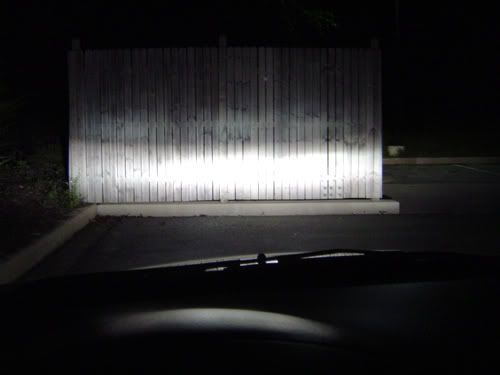
heres a pic of my old glare, i never did get flashed, but i felt bad for traffic and eventually took it off. its the 4300k in oem housings.
stock halogen glare
hid kit glare (notice all the stray light above the cutoff)
Registered!!
iTrader: (11)
Joined: Nov 2003
Posts: 4,576
Likes: 0
From: Lakewood, 562
Rep Power: 321 Re: HID in TYC setup. With no projector conversion
All I want is my DC bus to stay as close to 14.4vdc as possible. If this means increased mechanical load on the motor, I expect the PCM to increase the motor idle to compensate.
I would really like to find an aftermarket ECU/PCM unit that would let me do all this, scale FI PWM for boost, and whatever else would be fun. Ive looked at Motec & some other brands; it looks interesting, aside from developing the initial fuel & timing maps.
Anyway, the topic is HID, and im on another planet. Ill quit rambling now and let everyone get back to business. It would be nice to have a thread or something here for all 7th gen engineering data...would save on late-night search time.
Thanks again for the info though, i'll be installing those relays asap & post results after I figure out whats up.
I would really like to find an aftermarket ECU/PCM unit that would let me do all this, scale FI PWM for boost, and whatever else would be fun. Ive looked at Motec & some other brands; it looks interesting, aside from developing the initial fuel & timing maps.
Anyway, the topic is HID, and im on another planet. Ill quit rambling now and let everyone get back to business. It would be nice to have a thread or something here for all 7th gen engineering data...would save on late-night search time.
Thanks again for the info though, i'll be installing those relays asap & post results after I figure out whats up.
THe only time it, dimes a little is when i turn on the ac.
Its probably the ballasts or the wiring somewhere. Try getting oem ballasts. The most reliable hid setups are the ones that use oem parts.

