


Manual Trans, hard to get into first and reverse.


Thread Starter
Registered!!
Joined: Sep 2013
Posts: 30
Likes: 0
Rep Power: 0 
Manual Trans, hard to get into first and reverse.
Quick question...I did some searching and didn't really find much.
Car details: 2005 Civic LX Sedan, 5 Speed Manual, 101,000 miles. Original clutch.
My car sometimes doesn't like to go into first gear. When completely stopped, sometimes it goes into first easily and sometimes I have to put it into third or second and then into first. The clutch pedal is to the floor. Also, it almost never wants to go into reverse (Again, completely stopped) without some finesse.
It shifts fine otherwise. Is this a normal Civic thing or can I attribute it to a worn clutch? We can't adjust our clutches, correct?
What is a typical clutch life expectancy (I know this is a very, very tough question to answer...no flaming needed!)? Assuming "normal" driving, what is the expected life? 100,000 miles? 150,000 miles?
Car details: 2005 Civic LX Sedan, 5 Speed Manual, 101,000 miles. Original clutch.
My car sometimes doesn't like to go into first gear. When completely stopped, sometimes it goes into first easily and sometimes I have to put it into third or second and then into first. The clutch pedal is to the floor. Also, it almost never wants to go into reverse (Again, completely stopped) without some finesse.
It shifts fine otherwise. Is this a normal Civic thing or can I attribute it to a worn clutch? We can't adjust our clutches, correct?
What is a typical clutch life expectancy (I know this is a very, very tough question to answer...no flaming needed!)? Assuming "normal" driving, what is the expected life? 100,000 miles? 150,000 miles?

Registered!!
Joined: Mar 2011
Posts: 2,499
Likes: 5
Rep Power: 210 

Re: Manual Trans, hard to get into first and reverse.
what you are describing (in my experience) seems normal with pretty much any manual transmission,
the life expectancy of a clutch is determined solely by the driver, if a manual transmission/clutch is driven "properly" there is no reason why it should not last the lifetime of the vehicle
the life expectancy of a clutch is determined solely by the driver, if a manual transmission/clutch is driven "properly" there is no reason why it should not last the lifetime of the vehicle
Thread Starter
Registered!!
Joined: Sep 2013
Posts: 30
Likes: 0
Rep Power: 0 Re: Manual Trans, hard to get into first and reverse.
I disagree with the clutch lasting the lifetime of the vehicle. Especially when the vehicle can last 200,000+ miles. It is a wear item, much like brake pads. While it is possible to make a clutch last a very long time, it will still wear out. The clutch disk is constanly mating with the flywheel, both of which are moving at different speeds. It is going to wear out.
I have no idea who the first owner of my car was. The second owner was a mature female who went pretty easy on the car. She had it for 60,000 miles. I drive even easier than she did.
The other 5/6 speed cars I owned never had the first gear issue. Reverse maybe, but not first.
My 210,000 mile Geo Metro with the original clutch didn't like going into gear, but that is a different story.
I have no idea who the first owner of my car was. The second owner was a mature female who went pretty easy on the car. She had it for 60,000 miles. I drive even easier than she did.
The other 5/6 speed cars I owned never had the first gear issue. Reverse maybe, but not first.
My 210,000 mile Geo Metro with the original clutch didn't like going into gear, but that is a different story.
Registered!!
Joined: Mar 2011
Posts: 2,499
Likes: 5
Rep Power: 210 Re: Manual Trans, hard to get into first and reverse.
I disagree with the clutch lasting the lifetime of the vehicle. Especially when the vehicle can last 200,000+ miles. It is a wear item, much like brake pads. While it is possible to make a clutch last a very long time, it will still wear out. The clutch disk is constanly mating with the flywheel, both of which are moving at different speeds. It is going to wear out.
pretty much every moving part on your car is a wear item, that does not mean they will not last the lifetime of your vehicle,
your piston rings wear every time the piston goes up and down, so should your piston rings not last the lifetime of your vehicle?
your wheel bearings wear every time your wheel rotates, so should your wheel bearings not last the lifetime of your vehicle?
your valves and camshaft wear every time your cam turns and a valve opens and closes, so should they not last the lifetime of your vehicle?
your transmission gears wear ever time they rotate and make contact with one another, so should they not last the lifetime of your vehicle?
would you like me to continue????
Thread Starter
Registered!!
Joined: Sep 2013
Posts: 30
Likes: 0
Rep Power: 0 Re: Manual Trans, hard to get into first and reverse.
sorry but your logic is flawed,
pretty much every moving part on your car is a wear item, that does not mean they will not last the lifetime of your vehicle,
your piston rings wear every time the piston goes up and down, so should your piston rings not last the lifetime of your vehicle?
your wheel bearings wear every time your wheel rotates, so should your wheel bearings not last the lifetime of your vehicle?
your valves and camshaft wear every time your cam turns and a valve opens and closes, so should they not last the lifetime of your vehicle?
your transmission gears wear ever time they rotate and make contact with one another, so should they not last the lifetime of your vehicle?
would you like me to continue????
pretty much every moving part on your car is a wear item, that does not mean they will not last the lifetime of your vehicle,
your piston rings wear every time the piston goes up and down, so should your piston rings not last the lifetime of your vehicle?
your wheel bearings wear every time your wheel rotates, so should your wheel bearings not last the lifetime of your vehicle?
your valves and camshaft wear every time your cam turns and a valve opens and closes, so should they not last the lifetime of your vehicle?
your transmission gears wear ever time they rotate and make contact with one another, so should they not last the lifetime of your vehicle?
would you like me to continue????
Why don't you be reasonable? The chances of a clutch wearing out in a given number of miles is far greater than the chances of a camshaft wearing out.
Thread Starter
Registered!!
Joined: Sep 2013
Posts: 30
Likes: 0
Rep Power: 0 Re: Manual Trans, hard to get into first and reverse.
sorry but your logic is flawed,
pretty much every moving part on your car is a wear item, that does not mean they will not last the lifetime of your vehicle,
your piston rings wear every time the piston goes up and down, so should your piston rings not last the lifetime of your vehicle?
your wheel bearings wear every time your wheel rotates, so should your wheel bearings not last the lifetime of your vehicle?
your valves and camshaft wear every time your cam turns and a valve opens and closes, so should they not last the lifetime of your vehicle?
your transmission gears wear ever time they rotate and make contact with one another, so should they not last the lifetime of your vehicle?
would you like me to continue????
pretty much every moving part on your car is a wear item, that does not mean they will not last the lifetime of your vehicle,
your piston rings wear every time the piston goes up and down, so should your piston rings not last the lifetime of your vehicle?
your wheel bearings wear every time your wheel rotates, so should your wheel bearings not last the lifetime of your vehicle?
your valves and camshaft wear every time your cam turns and a valve opens and closes, so should they not last the lifetime of your vehicle?
your transmission gears wear ever time they rotate and make contact with one another, so should they not last the lifetime of your vehicle?
would you like me to continue????
Your wheel bearing did not last the lifetime of your vehicle. Correct???
If you don't want to post anything useful, go find another thread.

If you think a good mechanic is expensive, try hiring a bad one
Joined: Dec 2011
Posts: 32,017
Likes: 256
From: Midwest. Aiming about mid-chest
Rep Power: 519 Re: Manual Trans, hard to get into first and reverse.
The clutch disk is constanly mating with the flywheel, both of which are moving at different speeds.
Under what conditions are these moving at the same speeds?
Wear of the clutch disc only occurs under one condition.
The life expectancy of a clutch lining depends entirely upon the driver.
A person that is good with a clutch can make it last an awful long time.
Another person might have the clutch ruined in just a few feet of movement, or a matter of seconds.
Thread Starter
Registered!!
Joined: Sep 2013
Posts: 30
Likes: 0
Rep Power: 0 Re: Manual Trans, hard to get into first and reverse.
Under what conditions are these moving at different speeds?
Under what conditions are these moving at the same speeds?
Wear of the clutch disc only occurs under one condition.
The life expectancy of a clutch lining depends entirely upon the driver.
A person that is good with a clutch can make it last an awful long time.
Another person might have the clutch ruined in just a few feet of movement, or a matter of seconds.
Under what conditions are these moving at the same speeds?
Wear of the clutch disc only occurs under one condition.
The life expectancy of a clutch lining depends entirely upon the driver.
A person that is good with a clutch can make it last an awful long time.
Another person might have the clutch ruined in just a few feet of movement, or a matter of seconds.
Technically, there is always a slight amount of slip, at all times, since there is only a friction connection between the flywheel and clutch disk. But, we won't get into that since that amount of slip is probably less than 1%.
So, is it normal to be picky about going into first? We will skip the life expectancy question. I was looking more for something like, yes, the Civic eats clutches or no, they can last a few hundred thousand miles with proper driving.
If you think a good mechanic is expensive, try hiring a bad one
Joined: Dec 2011
Posts: 32,017
Likes: 256
From: Midwest. Aiming about mid-chest
Rep Power: 519 Re: Manual Trans, hard to get into first and reverse.
Only when hitting the clutch pedal are they moving at different speeds.
There is zero wear when a clutch is fully engaged.
A good operator only slips a clutch (with a load) to take off from a dead stop.
As in 0 to 3 MPH, for example.
Once the vehicle is underway, every other engagement and disengagement is done with RPM matching and minimal loading, load (accelerator pedal) is never reapplied until the clutch is fully engaged. The clutch is treated like an "on/off" switch, if you will.
Technically, there is always a slight amount of slip, at all times, since there is only a friction connection between the flywheel and clutch disk. But, we won't get into that since that amount of slip is probably less than 1%.
A properly working clutch allows zero slippage while engaged. None.
Locked in a 1:1 ratio.
Real world: 1% slippage would be a huge problem for a clutch.
Sorry, you have misinformation and I felt an overwhelming need to educate.
I was looking more for something like, yes, the Civic eats clutches or no, they can last a few hundred thousand miles with proper driving.
The life expectancy of a clutch lining depends entirely upon the driver.
A person that is good with a clutch can make it last an awful long time.
Another person might have the clutch ruined in just a few feet of movement, or a matter of seconds.
So, is it normal to be picky about going into first?
When the shafts stop spinning inside the trans, the gears don't always come to rest in a position where the teeth are perfectly lined up, so sometimes a shaft needs to be rotated just a little bit to get the gear teeth to engage each other.
Engaging a different gear will usually cause the shafts to rotate just a little bit, now the gear you want (1st) might be better aligned when you try it the next time.
It has to do with - the shafts in the transmission are all at rest when you are stopped.
Even though the clutch is disengaged, it's still tough work for the teeth on 2 little bitty gears to force the shafts to rotate when you jam the shifter lever forward, and to some extent the wear of the gear teeth and synchronizer (hub and slider) assemblies affects how they slide and mesh.
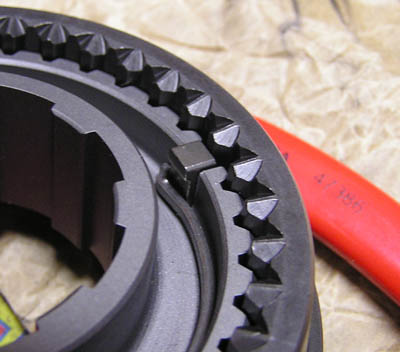
This is a hub and slider assembly. The sharp points of the teeth you can see on the outer ring (slider) in this pic
have to go past the teeth of the brass ring and engage with the "small nubby toothlets" (see arrows) of the gear shown here
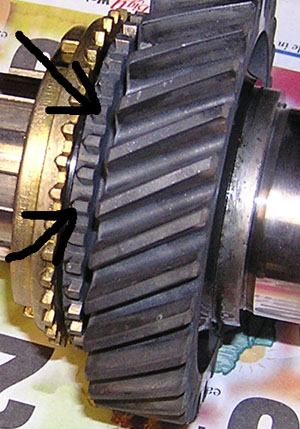
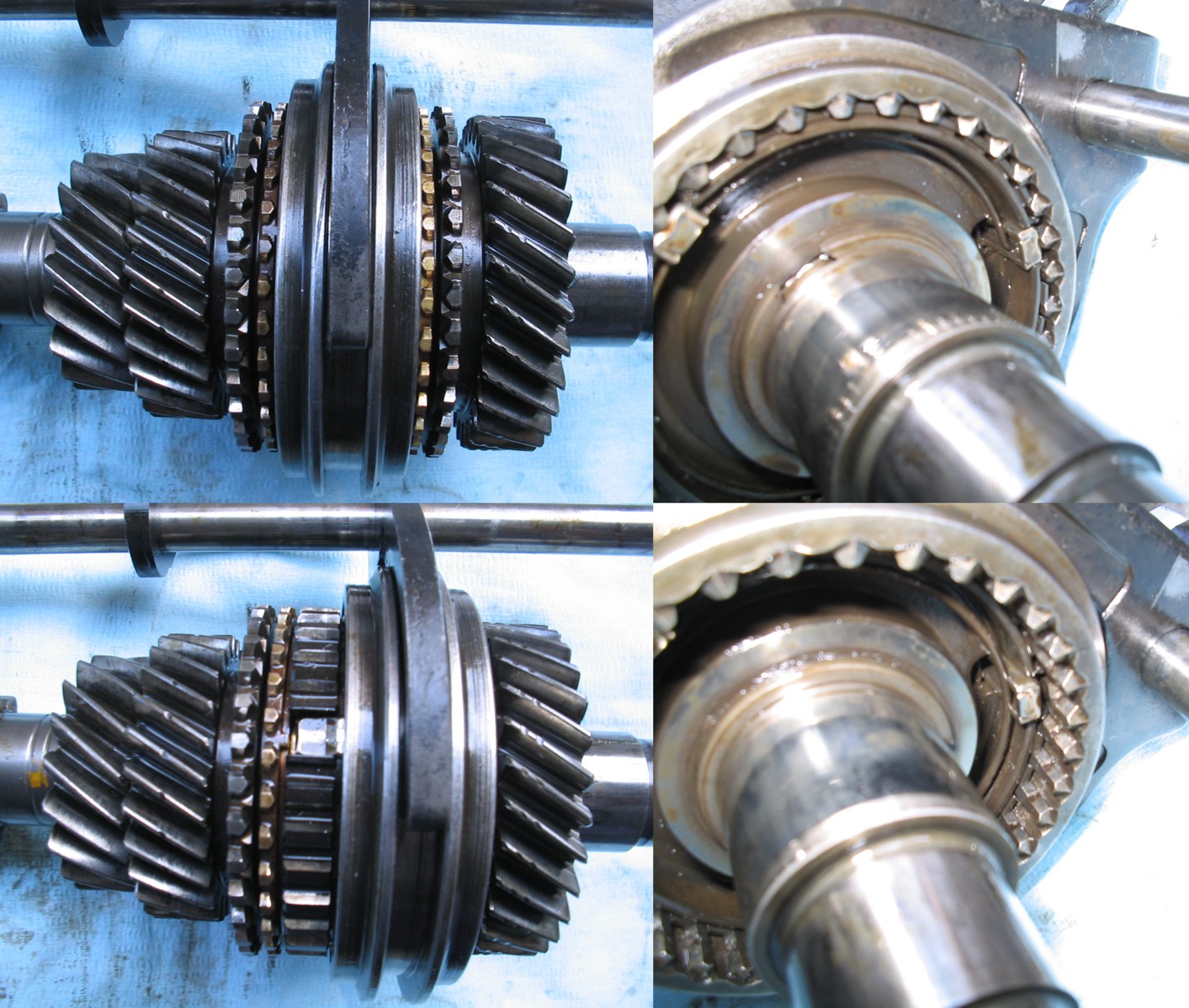
When new, those little teeth all have fairly sharp points on them, and can engage rather easily. As they wear the sharp tips of the teeth off, engagement can become a little more difficult.
Reverse gears have similar issues. The sides of the teeth have the sharpened tips, the tips of the teeth wear every time someone grinds them, and become more difficult to slide together to engage each time that happens.
There is no hub/slider/brass ring on reverse in this particular trans (only forward gears have them), to engage reverse on this trans you are physically moving a sliding idler gear into mesh with another gear - and these rely on the sides of the teeth having sharp points to ease engagement.
So I'm googling images for this post....This is the first one I see with the reverse gears, this was labeled as a Honda trans too.
I'm sure you can pick out all the chipped reverse gear teeth in this pic. You can see each gear had sharpened points on one side of the teeth. One gear has to slide in order to mesh with the other.

Here's a random reverse gear that has the points all rounded off the edges of the teeth. If this was in a Honda, I bet this would be a PITA to engage reverse:
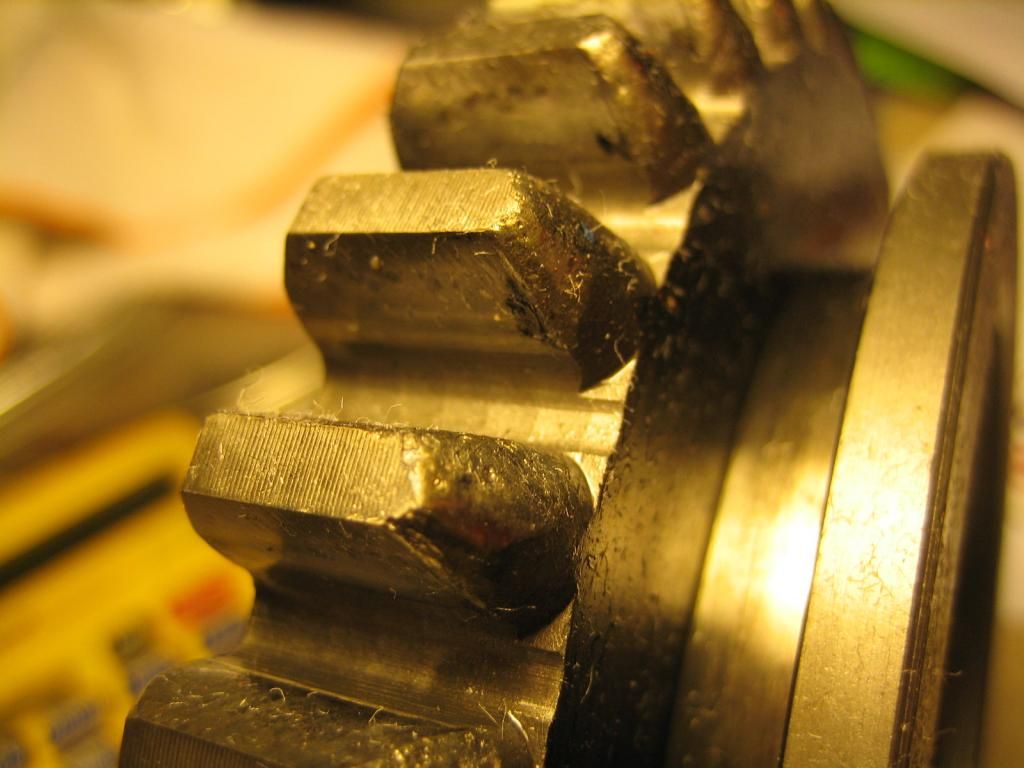
Also note, the reverse gears have all straight cut teeth while every other gear uses teeth cut at an angle. The straight cut teeth are what makes reverse whine so loudly.
Did that explain it good 'nuff?
Registered!!
Joined: Mar 2011
Posts: 2,499
Likes: 5
Rep Power: 210 Re: Manual Trans, hard to get into first and reverse.
dude, a clutch will only wear out if it is abused or driven by somebody who does not know how to operate it/use it properly, or a combination of those two things,
pretty much every part on your car can be classified as a "wear item", that does not mean you should have to expect to replace every single part on your car within its lifetime,
hell, even the rear brakes on these cars can last the lifetime of the vehicle,
a clutch is not an item that you should have to EXPECT to replace during the vehicles lifetime,
i stand by my previous remark, the lifetime of the clutch is determined by the operator of the vehicle,
Thread Starter
Registered!!
Joined: Sep 2013
Posts: 30
Likes: 0
Rep Power: 0 Re: Manual Trans, hard to get into first and reverse.
I am sorry you felt an overwhelming need to educate, which I find is an extremely confident statement following a very general, oversimplified explanation of an automotive clutch that simply isn't true in the world of physics.
My wording in my post should have been, "Technically, there is always a slight amount of slip, under certain conditions, since there is only a friction connection between the flywheel and clutch disk".
Let's discuss further, shall we? After reading some of my included sources and finding some of your own, I'd love to hear what your reaction is to what the world of physics can offer us.
First, I said your explanation wasn't true. A clutch relies on FRICTION! It doesn't "lock" in a 1:1 ratio, unless of course it is some kind of clutch that can physically lock. As far as I know, the 7th Gen Civic clutch is not a lock up design. As you know, the clutch disk is sandwiched between the pressure plate and the flywheel. There are no tabs, locks, mechanisms that "lock" the flywheel to the clutch disk. It is FRICTION that holds the clutch disk to transmit the engine's power to the transmission.
http://en.wikipedia.org/wiki/Stick-slip_phenomenon Here is a great Wiki article to read up on. It explains stick-slip. "Stick" is what is described when the clutch is engaged. Stick can be overcome by the engine's torque, but there are factors that can affect the holding properties of the clutch. The coefficient of friction can change due to temperature, friction material properties, oil contamination, water, rate of torque application, velocity, the list goes on. You can read some more here: http://www.pemltd.com/pdf/determining-the-static.pdf
If we use the example of driving on a straight and level road, with no wind, hills or other factors, the "stick" of the clutch should not be overcome if the auto manufacturer properly chose a clutch. But, add in those real world factors and the "stick" of the clutch can be overcome. Think of stomping on the gas trying to make it up a hill. The rate of torque changes and it is very possible that it can overcome the coefficient of friction. From the above Wiki article, "If an applied force is large enough to overcome the static friction, then the reduction of the friction to the kinetic friction can cause a sudden jump in the velocity of the movement". Or put in a different way, if the engine puts out enough torque, the clutch will not be able to hold it and will slip.
The coefficient of friction is what differentiates the holding power of an organic material versus a sintered iron material. Above I mentioned some other factors that can change the coefficient of friction. When the coefficient changes, so does the stick of the clutch and therefore the amount of torque the clutch can transmit without slipping.
Here is some more info on friction and clutches.
http://www.roymech.co.uk/Useful_Tables/Tribology/co_of_frict.htm
http://www.roymech.co.uk/Useful_Tables/Drive/Brake_Clutch_mat.html
This paper is pretty math intense, but it mathematically shows how engine torque can overcome the clutch when sticking. "The sticking of the clutch sustains as long as the torque transmitted through clutch (Tc) remains below the maximally transmittable torque Tmax c..."
http://www.mate.tue.nl/mate/pdfs/4159.pdf
You said that slipping at 1% would be a huge problem for a clutch. To correct you, I said, "Less than 1%". Less than 1% is a range of numbers from .999(repeating)% down to an infinitely small percent. I didn't specify because I don't have the data to estimate this, so I generalized. This percent could be .0000001% over a 30 minute drive at 60 mph (which would be something like .007296th of a revolution) and the percent slip does not mean the clutch is constantly slipping. Simply put, it slips here and there. I should have worded my previous post to be, "The average slip is probably less than 1%". However, even though the percent is very, very small, it still means the clutch is slipping.
Not to start another debate, but the same slip can be found with auto belt systems, tires rolling over the ground, etc. Friction can allow slip.
Do you understand my previous post's statement now? I will be sure to word my posts more clearly.
Last edited by MPGFTW; Feb 20, 2014 at 10:42 AM.
Thread Starter
Registered!!
Joined: Sep 2013
Posts: 30
Likes: 0
Rep Power: 0 Re: Manual Trans, hard to get into first and reverse.
not its not,
dude, a clutch will only wear out if it is abused or driven by somebody who does not know how to operate it/use it properly, or a combination of those two things,
pretty much every part on your car can be classified as a "wear item", that does not mean you should have to expect to replace every single part on your car within its lifetime,
hell, even the rear brakes on these cars can last the lifetime of the vehicle,
a clutch is not an item that you should have to EXPECT to replace during the vehicles lifetime,
i stand by my previous remark, the lifetime of the clutch is determined by the operator of the vehicle,
dude, a clutch will only wear out if it is abused or driven by somebody who does not know how to operate it/use it properly, or a combination of those two things,
pretty much every part on your car can be classified as a "wear item", that does not mean you should have to expect to replace every single part on your car within its lifetime,
hell, even the rear brakes on these cars can last the lifetime of the vehicle,
a clutch is not an item that you should have to EXPECT to replace during the vehicles lifetime,
i stand by my previous remark, the lifetime of the clutch is determined by the operator of the vehicle,
I assume the lifetime of this car to be over 300,000 miles. While there probably are cases where rear brakes have lasted that long, I seriously doubt this is the norm.
I also seriously doubt, even with amazing driving skills, that a clutch will last that long. There are outside factors that can attribute to a clutch wearing out. It can be contaminated with oil, water, dirt, etc and wear quicker. The driver can't help if they live in dusty conditions and dust can get everywhere is a car. Dust = particulate matter, which can aid in the quicker wear of a clutch.
I've worn clutches out, but never wore a camshaft out. Have you ever worn a camshaft out?? Can you show me proof that there are camshafts wearing out? What mechanics can talk about how many worn camshafts they have replaced vs how many clutches they have replaced?? Do you think the number of worn camshafts comes close to the number of worn clutches? No, it doesn't, but we do see clutch replacements, rear brakes, and other normal wear items being replaced.
You also used wheel bearings in a previous post. You yourself needed to replace wheel bearings, but you claimed they should last the lifetime of the vehicle. Why don't you explain your contradicting posts? If wheel bearings should last the lifetime of your car, why didn't yours last?
You are correct, pretty much every item is a wear item. But, Honda considers a clutch a "Standard Maintenance Item" and is therefore NOT covered by warranty. Here is a warranty book link: http://automobiles.honda.com/images/...ty-booklet.pdf Page 13, clutch, pressure plate and throwout bearing are not covered. But guess what, a camshaft is covered!
Are we done arguing over the fact that clutch can not be expected to last the lifetime of a car?? If Honda won't warranty a clutch, not even for the first 12,000 miles, it probably means that the clutch can be worn out well within the "lifetime" of a car.
Registered!!
Joined: Mar 2011
Posts: 2,499
Likes: 5
Rep Power: 210 Re: Manual Trans, hard to get into first and reverse.
i really do not understand people like you,
you come to a public forum and ask for peoples opinions about a specific subject, then you get upset because you do not agree with the opinions provided,
so why bother asking in the first place?
the only way a person like you will be happy with the opinions, is if we tell you what you want to hear and you agree with what we say,
i believe your clutch will fail you at exactly 137,960 miles, so you better replace it before you hit that mileage, is that what you want to hear? are you happy now?
what the hell difference does it make what we say? replace your damn clutch WHEN IT FAILS, and if it never fails then that is great!
if we told you the normal life expectancy of your clutch is 100,000 miles would you run to the shop right now and have it replaced? or would you keep driving because its still working? get the point?
you seem to be smarter than us all, and you already seem to know everything, so no point in me wasting any more time here
you come to a public forum and ask for peoples opinions about a specific subject, then you get upset because you do not agree with the opinions provided,
so why bother asking in the first place?
the only way a person like you will be happy with the opinions, is if we tell you what you want to hear and you agree with what we say,
i believe your clutch will fail you at exactly 137,960 miles, so you better replace it before you hit that mileage, is that what you want to hear? are you happy now?
what the hell difference does it make what we say? replace your damn clutch WHEN IT FAILS, and if it never fails then that is great!
if we told you the normal life expectancy of your clutch is 100,000 miles would you run to the shop right now and have it replaced? or would you keep driving because its still working? get the point?
you seem to be smarter than us all, and you already seem to know everything, so no point in me wasting any more time here
Thread Starter
Registered!!
Joined: Sep 2013
Posts: 30
Likes: 0
Rep Power: 0 Re: Manual Trans, hard to get into first and reverse.
i really do not understand people like you,
you come to a public forum and ask for peoples opinions about a specific subject, then you get upset because you do not agree with the opinions provided,
so why bother asking in the first place?
the only way a person like you will be happy with the opinions, is if we tell you what you want to hear and you agree with what we say,
i believe your clutch will fail you at exactly 137,960 miles, so you better replace it before you hit that mileage, is that what you want to hear? are you happy now?
what the hell difference does it make what we say? replace your damn clutch WHEN IT FAILS, and if it never fails then that is great!
if we told you the normal life expectancy of your clutch is 100,000 miles would you run to the shop right now and have it replaced? or would you keep driving because its still working? get the point?
you seem to be smarter than us all, and you already seem to know everything, so no point in me wasting any more time here
you come to a public forum and ask for peoples opinions about a specific subject, then you get upset because you do not agree with the opinions provided,
so why bother asking in the first place?
the only way a person like you will be happy with the opinions, is if we tell you what you want to hear and you agree with what we say,
i believe your clutch will fail you at exactly 137,960 miles, so you better replace it before you hit that mileage, is that what you want to hear? are you happy now?
what the hell difference does it make what we say? replace your damn clutch WHEN IT FAILS, and if it never fails then that is great!
if we told you the normal life expectancy of your clutch is 100,000 miles would you run to the shop right now and have it replaced? or would you keep driving because its still working? get the point?
you seem to be smarter than us all, and you already seem to know everything, so no point in me wasting any more time here
I was looking for opinions. You provided me with the opinion, "Your clutch should last the lifetime of your car if driven properly". Got it. My opinion does not agree with yours. If clutches are supposed to last the lifetime of the car, why do so many people replace them? Can you answer that without getting mad?
I am not mad or upset with the opinion you have provided. You and ezone are the only two people that have posted. Ezone said a clutch should last a long time. Should. Got it.
I am also still waiting on your answer to your conflicting post.
pretty much every moving part on your car is a wear item, that does not mean they will not last the lifetime of your vehicle,
your wheel bearings wear every time your wheel rotates, so should your wheel bearings not last the lifetime of your vehicle?
Why didn't your wheel bearings last the lifetime of your vehicle even though you think they should last the lifetime of your vehicle?? See how this is conflicting? You try to post an example of what you thought was a lifetime component and you yourself had that component fail on you. This really takes away from your opinion’s credibility.
Instead of telling me the same thing over and over again, why don't you actually contribute to this thread or stop adding to your post count. Give me some useful information, such as, "XXX's clutch lasted him 230,000 miles", check out this thread". Or, "YYY's clutch lasted 50,000 miles because he is a bad driver". That would be useful info. Can you provide that? With 700+ posts, you surely have seen a lot of this forum and can add something to this conversation, right? Repeated, overly generalized statements don't do much for me. You also said my logic was flawed, by using examples that compare apples to dump trucks. Camshaft wear vs clutch wear? Not even close, not by a mile.
Lastly, I never claimed to be smarter than anyone. Maybe you feel intimidated because I look for facts in a forum, instead of just believing mikey1 from the internet??
If you think a good mechanic is expensive, try hiring a bad one
Joined: Dec 2011
Posts: 32,017
Likes: 256
From: Midwest. Aiming about mid-chest
Rep Power: 519 Re: Manual Trans, hard to get into first and reverse.
However, if an engines torque can cause a properly working clutch to slip significantly and continuously, then IMO the clutch is improper for the application (size/friction surface area/clamping force/whatever).
The clutches in these cars do well with the stock engines. Once you start making real power, the stock clutch quickly becomes overwhelmed.
If clutches are supposed to last the lifetime of the car, why do so many people replace them?
Check out how long clutches last in HD trucking applications. A million miles or so is not unheard of?
I've worn clutches out, but never wore a camshaft out. Have you ever worn a camshaft out??
Any non-roller valvetrain has tremendous shear forces between the lobe and the follower.
Improper oil (and dirt, neglect) contributes greatly to cam lobe and cam follower wear.
Yes, I've seen several cams both worn and worn out in my career.
I don't think I have ever owned a car long enough to be the one to wear one out though, but my father did.
============
Somewhere in this mess I thought I saw something about the rear brakes, but I can't find it.
......I'll say that the drum brakes that Honda uses DO last an incredibly long time. I'd guess 5:1 over (longer than) the front brakes, if not more. (For the majority of the customers in the shop I work for, that ends up being well past 200k.) We do not stock rear brake shoes at all, we'd never sell them.
Disc brake life in the rear seems about on par with the fronts on most of the cars though.
YW. HTH
Thread Starter
Registered!!
Joined: Sep 2013
Posts: 30
Likes: 0
Rep Power: 0 Re: Manual Trans, hard to get into first and reverse.
I'll agree with the second statement much more than the first.
However, if an engines torque can cause a properly working clutch to slip significantly and continuously, then IMO the clutch is improper for the application (size/friction surface area/clamping force/whatever).
The clutches in these cars do well with the stock engines. Once you start making real power, the stock clutch quickly becomes overwhelmed.
Probably because 90% of the people driving manual transmissions have never been taught proper techniques. JMO.
Check out how long clutches last in HD trucking applications. A million miles or so is not unheard of?
Old small block Chevy, up until....maybe late 70s? They wore cam lobes off regularly. Every 80k or so. Well known for it.
Any non-roller valvetrain has tremendous shear forces between the lobe and the follower.
Improper oil (and dirt, neglect) contributes greatly to cam lobe and cam follower wear.
Yes, I've seen several cams both worn and worn out in my career.
I don't think I have ever owned a car long enough to be the one to wear one out though, but my father did.
============
Somewhere in this mess I thought I saw something about the rear brakes, but I can't find it.
......I'll say that the drum brakes that Honda uses DO last an incredibly long time. I'd guess 5:1 over (longer than) the front brakes, if not more. (For the majority of the customers in the shop I work for, that ends up being well past 200k.) We do not stock rear brake shoes at all, we'd never sell them.
Disc brake life in the rear seems about on par with the fronts on most of the cars though.
YW. HTH
However, if an engines torque can cause a properly working clutch to slip significantly and continuously, then IMO the clutch is improper for the application (size/friction surface area/clamping force/whatever).
The clutches in these cars do well with the stock engines. Once you start making real power, the stock clutch quickly becomes overwhelmed.
Probably because 90% of the people driving manual transmissions have never been taught proper techniques. JMO.
Check out how long clutches last in HD trucking applications. A million miles or so is not unheard of?
Old small block Chevy, up until....maybe late 70s? They wore cam lobes off regularly. Every 80k or so. Well known for it.
Any non-roller valvetrain has tremendous shear forces between the lobe and the follower.
Improper oil (and dirt, neglect) contributes greatly to cam lobe and cam follower wear.
Yes, I've seen several cams both worn and worn out in my career.
I don't think I have ever owned a car long enough to be the one to wear one out though, but my father did.
============
Somewhere in this mess I thought I saw something about the rear brakes, but I can't find it.
......I'll say that the drum brakes that Honda uses DO last an incredibly long time. I'd guess 5:1 over (longer than) the front brakes, if not more. (For the majority of the customers in the shop I work for, that ends up being well past 200k.) We do not stock rear brake shoes at all, we'd never sell them.
Disc brake life in the rear seems about on par with the fronts on most of the cars though.
YW. HTH
Yes, unfortunately my hands can't always get my thoughts out onto the keyboard correctly. Sorry for the confusion.
I absolutely agree with your clutch statements. Under most normal conditions, a clutch should never slip.
I drove a truck down a driveway once (a long driveway...). The first thing the owner told me was that you don't use the clutch after you get the truck rolling. I can believe a semi's clutch can last that long considering they don't use them aside from getting the truck moving.
Camshafts. Yes, older engines did have issues with it. If we keep this discussion only to Hondas though, can we agree that the camshaft is not likely to wear out in let's say, 300,000 miles? With proper preventative maintenance, of course...
I pulled my drum off to check the linings and found that there was plenty of life left in my rear brakes. 200,000 miles is a lot of driving.
If you think a good mechanic is expensive, try hiring a bad one
Joined: Dec 2011
Posts: 32,017
Likes: 256
From: Midwest. Aiming about mid-chest
Rep Power: 519 Re: Manual Trans, hard to get into first and reverse.
The first thing the owner told me was that you don't use the clutch after you get the truck rolling.
I can believe a semi's clutch can last that long considering they don't use them aside from getting the truck moving.
I can believe a semi's clutch can last that long considering they don't use them aside from getting the truck moving.
The clutch in HD is only used to take off from a stop.
That's the only time it is subjected to wear. That's the only time there is slippage with a load on it.
You let the clutch all the way out with the engine at idle RPM (again, the 0 to 3 MPH range), and you don't ever hammer the throttle until your foot is completely off of the clutch pedal.
only to Hondas ...camshaft...
300,000 miles?
300,000 miles?
But I also have seen a few Hondas with cam and follower problems long before 100k.
I pulled my drum off to check the linings and found that there was plenty of life left in my rear brakes. 200,000 miles is a lot of driving.

Registered!!
Joined: Oct 2006
Posts: 23
Likes: 0
Rep Power: 0 Re: Manual Trans, hard to get into first and reverse.
Quick question...I did some searching and didn't really find much.
Car details: 2005 Civic LX Sedan, 5 Speed Manual, 101,000 miles. Original clutch.
My car sometimes doesn't like to go into first gear. When completely stopped, sometimes it goes into first easily and sometimes I have to put it into third or second and then into first. The clutch pedal is to the floor. Also, it almost never wants to go into reverse (Again, completely stopped) without some finesse.
Car details: 2005 Civic LX Sedan, 5 Speed Manual, 101,000 miles. Original clutch.
My car sometimes doesn't like to go into first gear. When completely stopped, sometimes it goes into first easily and sometimes I have to put it into third or second and then into first. The clutch pedal is to the floor. Also, it almost never wants to go into reverse (Again, completely stopped) without some finesse.
As far as first gear? I can not tell you. But, as far as reverse, I can.
When its not going into reverse, do this. First put it in neutral and let the the clutch up. Now, put the clutch down, and shift into first, then second.. and back in neutral. You should then be able to easily engage reverse. It works easily every time I have needed it.
Gene

Thread
Thread Starter
Honda Civic Forum
Replies
Last Post
mohawkboom
I.C.E. (Audio) & Electrical Upgrades
67
Aug 25, 2015 12:28 AM
97-DX-Lover
Mechanical Problems/Vehicle Issues and Fix-it Forum
5
Jun 14, 2015 06:07 PM
oneheadlight
Mechanical Problems/Vehicle Issues and Fix-it Forum
3
Apr 29, 2015 11:30 PM
davidpaustin
Mechanical Problems/Vehicle Issues and Fix-it Forum
0
Apr 29, 2015 02:23 PM

