


Low temp thermostats?


Thread Starter
Registered!!
iTrader: (1)
Joined: Nov 2017
Posts: 1,521
Likes: 39
From: Memphis, TN
Rep Power: 119 
Low temp thermostats?
I have 2 main questions on low temp thermostats that no one seems to have the answer to. Thanks in advance to anyone who has answers
1. What is the effect of lower temperature thermostats on the engine's performance? I have seen dyno tests that show that the colder the coolant is the more power the engine makes, but I also seen tests showing that engines make the most power when fully warmed up, so a low temp thermostat could be counterproductive.
2. How would a lower temp thermostat affect the engine's longevity? I have seen companies claim that their low temp thermostats help reduce wear, but I would think that the engine's longevity could be adversely affected by running cooler than it is designed to run.
1. What is the effect of lower temperature thermostats on the engine's performance? I have seen dyno tests that show that the colder the coolant is the more power the engine makes, but I also seen tests showing that engines make the most power when fully warmed up, so a low temp thermostat could be counterproductive.
2. How would a lower temp thermostat affect the engine's longevity? I have seen companies claim that their low temp thermostats help reduce wear, but I would think that the engine's longevity could be adversely affected by running cooler than it is designed to run.
Last edited by D17VTECPOWER; Aug 11, 2019 at 06:31 PM.


Thread Starter
Registered!!
iTrader: (1)
Joined: Nov 2017
Posts: 1,521
Likes: 39
From: Memphis, TN
Rep Power: 119 Thread Starter
Registered!!
iTrader: (1)
Joined: Nov 2017
Posts: 1,521
Likes: 39
From: Memphis, TN
Rep Power: 119 
Mother of Vicci
Joined: Aug 2024
Posts: 34
Likes: 4
From: Wisconsin
Rep Power: 0 
Re: Low temp thermostats?
Well, the 7th gen Civics were known to have issues running hot and cracking head gaskets. Not sure where you live, but if you're commuting every day with it and summer tempts regularly get up to 80+ it certainly could help.
Hell, I found this post because I'm interested in doing the same for mine.
Also worth noting: the low temp thermos aren't open all the time. It'll still let your car heat up to operating temps, just on the lower end of the operating range. Which is good -- the less extreme the temperature fluctuations, the better for components under the hood.
Looks like they're $50-$100 USD, I say send it.
Hell, I found this post because I'm interested in doing the same for mine.
Also worth noting: the low temp thermos aren't open all the time. It'll still let your car heat up to operating temps, just on the lower end of the operating range. Which is good -- the less extreme the temperature fluctuations, the better for components under the hood.
Looks like they're $50-$100 USD, I say send it.
Thread Starter
Registered!!
iTrader: (1)
Joined: Nov 2017
Posts: 1,521
Likes: 39
From: Memphis, TN
Rep Power: 119 Re: Low temp thermostats?
Well, the 7th gen Civics were known to have issues running hot and cracking head gaskets. Not sure where you live, but if you're commuting every day with it and summer tempts regularly get up to 80+ it certainly could help.
Hell, I found this post because I'm interested in doing the same for mine.
Also worth noting: the low temp thermos aren't open all the time. It'll still let your car heat up to operating temps, just on the lower end of the operating range. Which is good -- the less extreme the temperature fluctuations, the better for components under the hood.
Looks like they're $50-$100 USD, I say send it.
Hell, I found this post because I'm interested in doing the same for mine.
Also worth noting: the low temp thermos aren't open all the time. It'll still let your car heat up to operating temps, just on the lower end of the operating range. Which is good -- the less extreme the temperature fluctuations, the better for components under the hood.
Looks like they're $50-$100 USD, I say send it.
The 7th gens are known for head gasket issues, but I haven't seen any evidence that the normal operating temperatures are the cause. Unlike most engines which overheat and then blow the head gasket, the D17's often just randomly blow the head gasket and then start to overheat, which quickly makes the leak worse.
I wouldn't suggest a low temp thermostat. I don't believe it would do anything to prevent the infamous blown head gasket, it will definitely reduce fuel efficiency, and will probably cause increased wear. Numerous studies show that wear is highest on a cold start and gradually decreases as the engine reaches full operating temperature, which a lower temp thermostat will prevent. Here's a graph of cylinder wear at different coolant temperatures according to a study done by Lycoming aviation if I remember correctly.
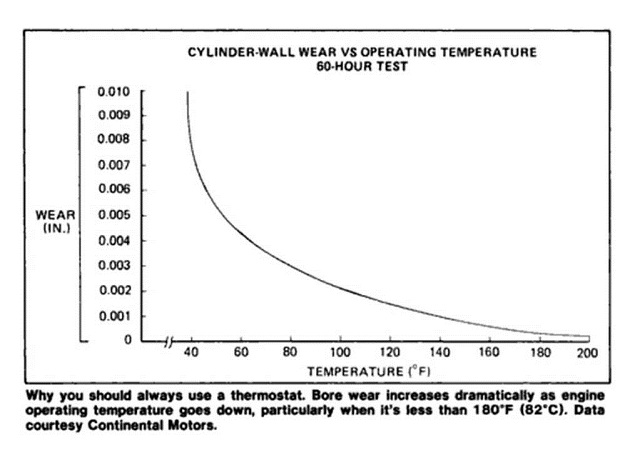
Another major issue is that the engine and the oil needs to regularly get hot to evaporate condensation and unburned fuel from the oil and for the oil to keep the engine clean. This is the reason why repeated short trips are considered severe service in the maintenance schedule and require more frequent oil changes. A lower coolant temperature would only make that worse. Also, remember that the oil can take 15-20+ minutes to fully warm up. I have an oil temp gauge and can confirm.
The outside air temperature is largely irrelevant as far as coolant temp is concerned in most cases. Sure, extreme cold can delay warmup and sustained very heavy loads in extreme heat can cause higher coolant temperatures, but in the vast majority of situations, the thermostat will keep the temp constant regardless of outside temp and a lower temp thermostat won't help in either of those scenarios anyways.


Registered!!
Joined: Jun 2021
Posts: 19
Likes: 9
From: northeast USA
Rep Power: 0 Re: Low temp thermostats?
5+ year old post.
The 7th gens are known for head gasket issues, but I haven't seen any evidence that the normal operating temperatures are the cause. Unlike most engines which overheat and then blow the head gasket, the D17's often just randomly blow the head gasket and then start to overheat, which quickly makes the leak worse.
I wouldn't suggest a low temp thermostat. I don't believe it would do anything to prevent the infamous blown head gasket, it will definitely reduce fuel efficiency, and will probably cause increased wear. Numerous studies show that wear is highest on a cold start and gradually decreases as the engine reaches full operating temperature, which a lower temp thermostat will prevent. Here's a graph of cylinder wear at different coolant temperatures according to a study done by Lycoming aviation if I remember correctly.
Another major issue is that the engine and the oil needs to regularly get hot to evaporate condensation and unburned fuel from the oil and for the oil to keep the engine clean. This is the reason why repeated short trips are considered severe service in the maintenance schedule and require more frequent oil changes. A lower coolant temperature would only make that worse. Also, remember that the oil can take 15-20+ minutes to fully warm up. I have an oil temp gauge and can confirm.
The outside air temperature is largely irrelevant as far as coolant temp is concerned in most cases. Sure, extreme cold can delay warmup and sustained very heavy loads in extreme heat can cause higher coolant temperatures, but in the vast majority of situations, the thermostat will keep the temp constant regardless of outside temp and a lower temp thermostat won't help in either of those scenarios anyways.
The 7th gens are known for head gasket issues, but I haven't seen any evidence that the normal operating temperatures are the cause. Unlike most engines which overheat and then blow the head gasket, the D17's often just randomly blow the head gasket and then start to overheat, which quickly makes the leak worse.
I wouldn't suggest a low temp thermostat. I don't believe it would do anything to prevent the infamous blown head gasket, it will definitely reduce fuel efficiency, and will probably cause increased wear. Numerous studies show that wear is highest on a cold start and gradually decreases as the engine reaches full operating temperature, which a lower temp thermostat will prevent. Here's a graph of cylinder wear at different coolant temperatures according to a study done by Lycoming aviation if I remember correctly.
Another major issue is that the engine and the oil needs to regularly get hot to evaporate condensation and unburned fuel from the oil and for the oil to keep the engine clean. This is the reason why repeated short trips are considered severe service in the maintenance schedule and require more frequent oil changes. A lower coolant temperature would only make that worse. Also, remember that the oil can take 15-20+ minutes to fully warm up. I have an oil temp gauge and can confirm.
The outside air temperature is largely irrelevant as far as coolant temp is concerned in most cases. Sure, extreme cold can delay warmup and sustained very heavy loads in extreme heat can cause higher coolant temperatures, but in the vast majority of situations, the thermostat will keep the temp constant regardless of outside temp and a lower temp thermostat won't help in either of those scenarios anyways.
Many forum members through the years asked about a lower temp thermostat for the same reasons as did on this forum. But at the end of the day, it's the maintenance that keeps an engine from overheating and knowing of the maintenance history if buying a used car. After 245k on one cruze and 160k on the other, I have had good luck regarding no catastrophic issues. Abeit the cruze 1.4 is a high maintenance car.
I'm enjoying my 03 EX so far and happy to find knowledgable forum members like yourself willing to help folks out. Happy holidays

Thread
Thread Starter
Honda Civic Forum
Replies
Last Post
spyglass
Mechanical Problems/Vehicle Issues and Fix-it Forum
4
Jun 10, 2013 06:08 PM
motayba
Mechanical Problems/Vehicle Issues and Fix-it Forum
6
Jan 4, 2011 01:07 PM
mr22508
Mechanical Problems/Vehicle Issues and Fix-it Forum
2
Nov 26, 2008 06:28 PM

