


Read before answering please!


Thread Starter
Registered!!
Joined: Sep 2012
Posts: 215
Likes: 0
Rep Power: 0 
Re: Read before answering please!
ezone, I learned a little bit about lubrication from your post, that is some good info.
Moon, yeah I would think it over before you use Rotella or something like it? What I did worked in an USA designed and built engine that is a tank of an engine. They do put up with a lot of abuse and handle it well..
Me personally, I would not use any oil in a Honda if it didn't meet Honda's SAE requirement. Or any engine for that matter. I still go look at what the OEM SAE requirement is and go with that. That isn't a cop out if it sound's like 1 it isn't meant to. I have seen oil related failures due to incorrect oil type and specs. I pretty much use OEM oil filters or NAPA Gold equivalent. Oil and filters are cheap compared to engine failure and downtime.
Rotella worked for me in that application. If the weight and specs, meet Honda's requirments that would be the deciding factor for me.. Also know the non synthetic is what was recommended to me, not synthetic.
My .02
Dadrider
Moon, yeah I would think it over before you use Rotella or something like it? What I did worked in an USA designed and built engine that is a tank of an engine. They do put up with a lot of abuse and handle it well..
Me personally, I would not use any oil in a Honda if it didn't meet Honda's SAE requirement. Or any engine for that matter. I still go look at what the OEM SAE requirement is and go with that. That isn't a cop out if it sound's like 1 it isn't meant to. I have seen oil related failures due to incorrect oil type and specs. I pretty much use OEM oil filters or NAPA Gold equivalent. Oil and filters are cheap compared to engine failure and downtime.
Rotella worked for me in that application. If the weight and specs, meet Honda's requirments that would be the deciding factor for me.. Also know the non synthetic is what was recommended to me, not synthetic.
My .02
Dadrider
The Rotella-T6 synth comes in 5W-40, that's what I use.
My 144K EX had a horrible previous owner with no sense of regular maintenance, so its oil was low with a VTEC CEL. That corrected, consumption (on Mobil 1) was awful at first, until I swapped in a qt R-T with the other quarts Mobil 1 5W-20 High Mileage. Consumed almost a quart in that first week... topped off with regular Mobil. By the end of the second week, consumption was normal. I also ran Gumout Regane High Mileage for a tank shortly after (polyetheramines are best fuel additives for top end cleaning, loosening the deposits in that top ring groove and injector tips). Changed oil/filter again due to the cleaner dirtying the oil, with the same qt R-T with the rest Mobil 1. Smooth sailing since.
My next change, I'll go full Mobil 1 5W-20, and see how things go. Being that my consumption went *down* with the R-T in there, figure it'll have a bit more power due to less going to viscous drag, and get a bit more response. If your consumption is a lot less than mine, though... don't use the R-T all the time, just a smaller amount like a half quart, it until you see a change or 1 month, whichever comes first. My Civic, even with the full quart, is nice and peppy now -- can't wait till May.
My 144K EX had a horrible previous owner with no sense of regular maintenance, so its oil was low with a VTEC CEL. That corrected, consumption (on Mobil 1) was awful at first, until I swapped in a qt R-T with the other quarts Mobil 1 5W-20 High Mileage. Consumed almost a quart in that first week... topped off with regular Mobil. By the end of the second week, consumption was normal. I also ran Gumout Regane High Mileage for a tank shortly after (polyetheramines are best fuel additives for top end cleaning, loosening the deposits in that top ring groove and injector tips). Changed oil/filter again due to the cleaner dirtying the oil, with the same qt R-T with the rest Mobil 1. Smooth sailing since.
My next change, I'll go full Mobil 1 5W-20, and see how things go. Being that my consumption went *down* with the R-T in there, figure it'll have a bit more power due to less going to viscous drag, and get a bit more response. If your consumption is a lot less than mine, though... don't use the R-T all the time, just a smaller amount like a half quart, it until you see a change or 1 month, whichever comes first. My Civic, even with the full quart, is nice and peppy now -- can't wait till May.
Also, I don't think it was answered, why not use high mileage oil?
Oh and I found this, http://www.honda.com/newsandviews/ar...=2003091748233, I have been putting in 4 quarts at a change, when really i'm only supposed to do 3.5. Will that help the burning?
Last edited by M00n3at3r; Apr 10, 2014 at 12:53 PM.

Registered!!
Joined: Jul 2009
Posts: 425
Likes: 1
Rep Power: 211 

Re: Read before answering please!
In the Civic I use Castrol 0w-30 while in my Toyota I will use the Castrol 0w-30 mostly or Mobil 1 0w-40. Both are the "European" formulas with API SN and ACEA A3/B3, A3/B4 ratings. I run 7,500 mile oil change intervals and even with 145,000 and 160,000 miles on the engines the oil is still light brown when it is changed.
I use Rotella T6 in a Honda ATV (JASO MA rating for the wet clutch) and Ford tractor. I have also used Rotella to clean up an engine (Jeep Cherokee 4.0l) but this was an engine that had no problems with 40 weight oil.
I think most oil additives are marketed to solve a problem that doesn't exist if you are using a decent oil.
I use Rotella T6 in a Honda ATV (JASO MA rating for the wet clutch) and Ford tractor. I have also used Rotella to clean up an engine (Jeep Cherokee 4.0l) but this was an engine that had no problems with 40 weight oil.
I think most oil additives are marketed to solve a problem that doesn't exist if you are using a decent oil.

*watches temp gauge like a hawkboss* :D
Joined: Feb 2014
Posts: 610
Likes: 1
From: Definitely older than ezone's skateboard. XD
Rep Power: 0 Re: Read before answering please!
Where would I find the SAE requirements?
So you only use a quart in with the other oil, not all Rotella?
Also, I don't think it was answered, why not use high mileage oil?
Oh and I found this, http://www.honda.com/newsandviews/ar...=2003091748233, I have been putting in 4 quarts at a change, when really i'm only supposed to do 3.5. Will that help the burning?
So you only use a quart in with the other oil, not all Rotella?
Also, I don't think it was answered, why not use high mileage oil?
Oh and I found this, http://www.honda.com/newsandviews/ar...=2003091748233, I have been putting in 4 quarts at a change, when really i'm only supposed to do 3.5. Will that help the burning?
Uh... yes. 3.5 qts if it's an EX. Have you not been checking your dipstick after running the motor five mins after a change? If not, make it a habit.
Supposedly using high mileage oil isn't necessary. However, if you've been using the regular synth formulations of a good engine oil, you apparently shouldn't have any problems. I have a problem with that, as if that were true, there wouldn't be a consumption issue in the first place. Lots of touring/cruisers bikes on my bench who've had religious dealer contract services... and still, there're deposits in the ring grooves when they trade them in on a new bike and I rebuilt them... part of the reason high-mileage oils exist, is to address the same ring-sticking problems, with an additive package. Used them with great success on my Paseo in the Mobil 1 brand (I'd say service limit compression after 280K is a good yardstick for that).
The reason I use not-all R-T, is just what ezone has been saying earlier in the thread and in other threads -- too much viscosity will prevent the oil from doing its job of, in order of importance -- cooling, cleaning, and lubricating. This is why making the entire crankcase full of 40 weight (at op temp) is definitely not recommended, as Honda didn't design the D17 to use 40 weight oil (my SV650, however, was designed to use 10W40, and my 280K Paseo 10W30 -- both of which got all and one qt R-T, respectively).
Sheezus, this has become a bona fide 'one of those damned oil grok threads'!
 Checking out... any other Qs, PM please.
And pjb3 -- I too reeeeaaally like R-T6 for its clutch feel in a moto/ATV (it's why I preferred it over Castrol Actevo in my street SV). Being that Civic engines don't share trans and engine oil though... prolly less of a sell.
 But in general, the change in engine oil consumption and fuel economy in the Civic from not using that last half-quart of R-T, to using it, is significant enough to notice during fillups, and when passing on the highway, after about a week or two of daily normal driving.
If you think a good mechanic is expensive, try hiring a bad one
Joined: Dec 2011
Posts: 32,017
Likes: 256
From: Midwest. Aiming about mid-chest
Rep Power: 520 Re: Read before answering please!
Remember what I said previously:
Yeah. That's all the SAE spec is.
Also, I don't think it was answered, why not use high mileage oil?
It can cause increased oil consumption, regardless of what the label tries to get you to believe.
Quote from post #27: Low kinematic viscosity is essential for proper cooling of these critical areas (piston rings, ring lands, and ring grooves). Thicker oil increases the oil temperature and ring area temperature.
^^That's how you get carbon buildup in the ring grooves.^^
And most reputable quality regular oil already has the conditioners for the seals, you don't gain anything from a "high mileage" labeled product..
=========================
More from my saved notes:
"High mileage" products were created and marketed based on the ability to extend the life of oil seals and gaskets, and reduce oil consumption.
In reality, they were usually thicker than the typical products of the same viscosity rating and did have better seal conditioning properties than SOME oil products.
Seal conditioning performance was not tested by API, ILSAC, and other rating systems until just recently. We now have excellent technology regarding seal conditioning and extending the life of oil seals and gaskets.
API, ILSAC and others now test and mandate much better seal conditioning than just a few years ago.
Most modern reputable oil producers already incorporate these conditioning technologies into their "regular" oils.
===========================
I have been putting in 4 quarts at a change, when really i'm only supposed to do 3.5. Will that help the burning?
Overfilling is bad.
The full mark on the dipstick means FULL. It doesn't mean keep adding more. Duh.
Many engines tend to seek their own oil level, meaning they may try to expel excess. Some might leak it, others burn it.
Audi and VW used to have warning labels about overfilling the engine oil, because oil burning can lead to destruction of the catalytic converter.
I have a problem with that, as if that were true, there wouldn't be a consumption issue in the first place.
Remember, SOME consumption is normal, expected, and designed into the engine.
SOME consumption can be caused by driving habits.
Also, engines do wear, and wear out.
had religious dealer contract services...
I also believe that driving habits and general use CAN vary so much between different drivers that sometimes a single set of specs sometimes might not be enough to cover all the possible conditions that could be encountered.
Extended highway driving/heavy duty towing (extreme loading)/extreme cold weather/soccer mom short trip/stop and go, etc. all place different demands on an engine. It can be difficult to spec something that can protect in all conditions.
We have engine designs with extremely narrow low tension rings that are very unforgiving of incorrect oil. Now add in todays extended drain intervals, 5k-10k-15k miles between oil changes. Todays high tech oils are already doing a tremendous job.
Questionable oils and additives just make the situation even less forgiving.
Sheezus, this has become a bona fide 'one of those damned oil grok threads'! Checking out... any other Qs, PM please.
Checking out... any other Qs, PM please. Please note: I'm no oil guru. I read what some trusted experts have to say, and I try to save a lot of notes for reference.
Thread Starter
Registered!!
Joined: Sep 2012
Posts: 215
Likes: 0
Rep Power: 0 Re: Read before answering please!
It's totally becoming one of those threads, but I'm learning! Or trying to. The best part is I can reference back to it. Now personally ezone, what would you do? Would running the rotella for an oil change or two and then switching to straight castrol, or whatever brand, and continue using that from now on clean it nicely so I have a "fresh"-ish start. AND I want my car to last forever.
Last edited by M00n3at3r; Apr 10, 2014 at 08:15 PM.
If you think a good mechanic is expensive, try hiring a bad one
Joined: Dec 2011
Posts: 32,017
Likes: 256
From: Midwest. Aiming about mid-chest
Rep Power: 520 Re: Read before answering please!
You already know what I'd do.
PLUS I check oil on a regular basis, on all of my gas engine powered stuff. Cars, truck, bike, mowers, etc.
AND I want my car to last forever. Be more realistic.
I don't know how it is where you are, but I'm in the rust belt.
Our goal here is to get miles racked up on it before the body rots away to nothing.
PLUS I check oil on a regular basis, on all of my gas engine powered stuff. Cars, truck, bike, mowers, etc.
AND I want my car to last forever.
I don't know how it is where you are, but I'm in the rust belt.
Our goal here is to get miles racked up on it before the body rots away to nothing.
*watches temp gauge like a hawkboss* :D
Joined: Feb 2014
Posts: 610
Likes: 1
From: Definitely older than ezone's skateboard. XD
Rep Power: 0 Re: Read before answering please!
Agree, except for the 'synth' part.
Oil consumption can have more causes than just sticking rings.
Remember, SOME consumption is normal, expected, and designed into the engine.
SOME consumption can be caused by driving habits.
Also, engines do wear, and wear out.
Dealers are free to use incorrect oils too, just like anyone else. (THINK CHEAP!)
We have engine designs with extremely narrow low tension rings that are very unforgiving of incorrect oil. Now add in todays extended drain intervals, 5k-10k-15k miles between oil changes. Todays high tech oils are already doing a tremendous job.
Questionable oils and additives just make the situation even less forgiving.
Oil consumption can have more causes than just sticking rings.
Remember, SOME consumption is normal, expected, and designed into the engine.
SOME consumption can be caused by driving habits.
Also, engines do wear, and wear out.
Dealers are free to use incorrect oils too, just like anyone else. (THINK CHEAP!)
We have engine designs with extremely narrow low tension rings that are very unforgiving of incorrect oil. Now add in todays extended drain intervals, 5k-10k-15k miles between oil changes. Todays high tech oils are already doing a tremendous job.
Questionable oils and additives just make the situation even less forgiving.
I had to address some points here just to clarify what was meant, and what was missed.
'Questionable oils and additives just make the situation even less forgiving.'
Unless it'd been tested in my own vehicles, successfully. Racing and four different street vehicles should be a wide enough delta to prove (at least to me) that my 'doping'-dose-of-RT6 methodology isn't inherently abusive, and should not accelerate wear or reduce the life of the hard parts. Since I'm well acquainted with the symptoms of compression loss and additional blowby due to reduced ring sealing, and have not seen any of these symptoms in any of my vehicles when using the RT6 in the oil, I can't agree it'd make the situation less forgiving.
'Dealers are free to use incorrect oils too, just like anyone else. (THINK CHEAP!)'
My dealer where Dave and I worked, only used OEM oils for all dealer services, unless the customer provided their own (specifically Pro Honda for all Hondas, Yamalube for Yamahas, Suzuki for Suzukis, etc.). No substitution was allowed or endorsed, at least when I was wrenching as a senior tech there. TBH, Yamaha's and Kawasaki's OEM sportbike oil (which was a pretty trick Motul formulation) were damned good in street applications.
'Oil consumption can have more causes than just sticking rings.
Remember, SOME consumption is normal, expected, and designed into the engine.
SOME consumption can be caused by driving habits.
Also, engines do wear, and wear out.'
Didja forget I was a 15+yr tech too?

Other than a leak, there aren't many other oil-pressurized sliding seals in the motor that are exposed to atmosphere, 2000 degF gas temps and 4200-ft/sec accelerations at redline... so it's the main one. Flutter is what claims most oil, along with matched gaps a close second (when matched, though it corrects itself given enough time). The old 'quart/1000 mi' rule still applies in 2014 despite much tighter tolerances, much more accurate manufacturing, and better oils? If you're consuming a quart in a month in a brand-new vehicle after proper break-in... I wouldn't ignore it. But in a 144K, 10-yr-old one like mine... it's definitely bore OOR if not ring-sticking, so a quart is more plausible (if not to be ignored).
'Agree, except for the synth part'
My last words on the usual oil shens (I promise)...

Synths are simply more stable and regular chain forms of hydrocarbon chains (oil), that are much more consistent than mineral oils, since all of the chains are close to the same length and homogenous, rather than a range of lengths, some more volatile and some less. The volatile, short ones are the ones that sublimate and leave out your exhaust to become a smog component. The longer ones, the 'heavy ends', become sludge. So a synthetic oil, if engineered properly for the application, will last longer, resist viscosity change, penetrate better (as we know from gasket leaks on engines designed for dino oil), pollute less, and retain the three abilities of oil -- cleaning, cooling, and lubing -- for longer and under more diverse conditions than dino. Since they flow better in the same SAE viscosities then mineral, they can also receive more additive packages without sacrificing that lack of viscosity.
If one of the main properties of oil that allow it to clean the ring grooves, is a thin enough viscosity to properly cool and carry away that heat to prevent localized cooking, why then would you resist a synthetic formulation? It by design, will leave behind less heavy ends in the grooves as deposits, and yet stay within viscosity so it can flow away with deposit debris, rather than off-gas and leave.
After a hard break-in with dino oil (still the best way to do that IMO)... synth all the way. I've raced with Castrol moto racing synths on a bike that'd done less than 50 mi on the dyno, as a break-in... no problems whatsoever. Used my racebike on the street as well with this break-in... zero street issues with consumption. But then again... I was using a synth with a far better protective additive package against sludge, carbon buildup, acids, or viscosity breakdown, than any gas engine oil.
If you think a good mechanic is expensive, try hiring a bad one
Joined: Dec 2011
Posts: 32,017
Likes: 256
From: Midwest. Aiming about mid-chest
Rep Power: 520 Re: Read before answering please!
Unless it'd been tested in my own vehicles, successfully. Racing and four different street vehicles should be a wide enough delta to prove (at least to me) that my 'doping'-dose-of-RT6 methodology isn't inherently abusive, and should not accelerate wear or reduce the life of the hard parts. Since I'm well acquainted with the symptoms of compression loss and additional blowby due to reduced ring sealing, and have not seen any of these symptoms in any of my vehicles when using the RT6 in the oil, I can't agree it'd make the situation less forgiving.
We are dealing only with carbon buildup in the oil ring groove.
Your bike engines aren't the same as the average econobox engine. The only real absolute similarity is they all burn gasoline.
We're really only dealing with the grocery getter econobox Civic engine here, normally driven by average people in typical grocery getter econobox modes and situations.
My dealer where Dave and I worked,
There are plenty of others in the auto world that don't adhere to manufacturer recommendations. There's at least one within a stones throw from me.
along with matched gaps a close second (when matched, though it corrects itself given enough time).
Remember, the average consumer will never, ever open the hood of their own car. Never ever check their own oil. Never ever put air in their own tires, completely ignoring the (!) icon on the dash for-freekin-ever.
"Gas goes in *here*, and as long as it can pull itself down the road then all must be perfect."
So, on the subject of ring gaps.......
This is out of the 14 van I did the other day. 10 k miles. Fouled a plug already, approx 1.75 quarts consumed in 5k miles:
The old 'quart/1000 mi' rule still applies in 2014 despite much tighter tolerances, much more accurate manufacturing, and better oils? If you're consuming a quart in a month in a brand-new vehicle after proper break-in... I wouldn't ignore it.
But in a 144K, 10-yr-old one like mine... it's definitely bore OOR if not ring-sticking, so a quart is more plausible (if not to be ignored).
'Agree, except for the synth part'
Originally Posted by kinakoes2

Supposedly using high mileage oil isn't necessary. However, if you've been using the regular synth formulations of a good engine oil, you apparently shouldn't have any problems.
Agree, except for the 'synth' part.
Plus, the wrong oil is still the wrong oil, no matter if it really is synthetic or not.
---------------------------------------
---------------------------------------
Our closest BMW dealer tells people that "any synthetic oil is good enough" (yes, I actually heard this on the phone).
The oil that keeps our cars alive can ruin a European engine in a short time.
The oil that keeps European engines alive can ruin our engines in a short time.
Both oil bottles might even "say" the same weight, such as 5w30...
The oil that keeps European engines alive can ruin our engines in a short time.
Both oil bottles might even "say" the same weight, such as 5w30...
Last edited by ezone; Apr 12, 2014 at 01:01 AM. Reason: pic resize
*watches temp gauge like a hawkboss* :D
Joined: Feb 2014
Posts: 610
Likes: 1
From: Definitely older than ezone's skateboard. XD
Rep Power: 0 Re: Read before answering please!
Sure it does (involve compression). What do you think happens when a ring gets stuck? Doesn't blowby happen? And wouldn't signs that compression isn't occurring properly (more oil consumption, higher engine temps, dirty EGR components and manifold interiors) be of diagnostic value? Of course it would.
Your bike engines aren't the same as the average econobox engine. The only real absolute similarity is they all burn gasoline. We're really only dealing with the grocery getter econobox Civic engine here, normally driven by average people in typical grocery getter econobox modes and situations.
There are plenty of others in the auto world that don't adhere to manufacturer recommendations. There's at least one within a stones throw from me.
[quote[How much time does it take? How much time will an average consumer put up with?[/quote]
Since any owner of a vehicle with an engine that uses multiple piston rings to seal, will experience ring gap matching (ring rotation is by design). And since that two-ring/two-gap design is still in production in nearly every IC piston street engine in existence... it doesn't seem to be very long before they overlap again. Otherwise, I'd have to get a rebuild every time it happened. That I don't, speaks to how long it takes -- not long, and certainly not long enough to concern an owner, not to mention an enthusiast.
Now... if the rings *stick* in this config... that's bad, but still not reason enough to tear an engine down. Just use a bit of RT6 with a good chamber cleaner like Regane with 0W20 oil, and it should free enough to begin moving again. Hell, you can probably get it to rotate with just the Regane.
Remember, the average consumer will never, ever open the hood of their own car. Never ever check their own oil. Never ever put air in their own tires, completely ignoring the (!) icon on the dash for-freekin-ever.
"Gas goes in *here*, and as long as it can pull itself down the road then all must be perfect."
"Gas goes in *here*, and as long as it can pull itself down the road then all must be perfect."

You can't have abuse/neglect tolerance designed into an engine, and make it more efficient, at the same time -- both are mutually-exclusive to each other, and something has to give. The very extra groove space that allows a ring to unstick by being able to move slightly axially off the groove floor, is the very one that allows HC to stick around and increase emissions. This is why top grooves are located higher and higher on pistons these days, to keep this area from containing HC in service (and forcing more and more sophisticated oils to be able to comply with the greater risk of cooking).
Honda apparently learned something about bringing these opposing goals closer together with subsequent gens, but as long as lacking owners never go away, neither will ring-sticking... cars being less and less neglect-tolerant, what with mpg and emissions being top engineering goals these days. Hell, you can't even take off the valve cover on the '15 Fit without unbolting the manifold? Factory hands and chemicals only, no aftermarket at all, seems like a continuing trend with no end in sight.
So, on the subject of ring gaps.......
This is out of the 14 van I did the other day. 10 k miles. Fouled a plug already, approx 1.75 quarts consumed in 5k miles:

This is out of the 14 van I did the other day. 10 k miles. Fouled a plug already, approx 1.75 quarts consumed in 5k miles:
Never actually measured a bore in these engines, but I'm fairly sure the bores aren't the issue.
See if you can find a high-mile (150K or more) motor in your circle of influence, and put a dial indicator bore gauge on it. Rings don't like to make anything but circles... well, when they seal, anyway.
The label "Synthetic" can be nearly meaningless in North America. A company can use a blend of 1% syn and get away with calling it synthetic. Again, interpreting the label and specs is key.
But they're vastly different oils when the rest of the specs are considered.
)... then sticking with (no pun intended) factory-specified oils will result in better longevity and service life, at least as far as 'better' is defined by the factory that makes your car.But in my case... 'different' is also 'better'. I can't reverse the abuse and neglect done to my engine until I took the reins... but I can control when it needs my attention, and just maybe, even make it run a bit better with some old-fashioned care... from outside the factory reccies. Don't get me wrong -- I don't diss Honda reccies, quite the opposite... but I do freely and intelligently choose when to part from them -- via my own testing.
If you think a good mechanic is expensive, try hiring a bad one
Joined: Dec 2011
Posts: 32,017
Likes: 256
From: Midwest. Aiming about mid-chest
Rep Power: 520 Re: Read before answering please!
Holy cow my pic made the whole mess get super wide.
Except for big twins AFAIK, so many of the motorcycle engines can turn insane RPMs when needed. The cars don't.
----------------------
Ring gap alignment is supposed to be a cause of the oil consumption on the V6 VCM engines in this link.http://www.autoblog.com/2013/10/23/h...wsuit-engines/
Quote from service information: "The piston rings on certain cylinders may rotate and align which can lead to spark plug fouling."
Why would this only happen on the cylinders equipped with VCM? (I don't know the answer.)
#1 thru 4 are affected, out of 6.
1-4 can be shut down during 3 or 4 cylinder modes but #5 and 6 are always being used. 5 and 6 are not affected.
The 2014 that piston came out of is not included in this warranty extension on the V6 engines. Honda wanted this short block back for further examination. I doubt I'll ever hear anything further about it.
My comments weren't directed you personally.
We can still have great compression with little blowby when just the oil control rings are stuck. You can completely remove the oil rings and still have decent compression. Oil control goes to hell though.
And a cat can hide a lot of oil smoke.
--------------------------------
I keep forgetting that driving habits can lead to rings sticking too. Hard use on a cold engine, and fuel quality have a lot to do with it. Carbon deposits can take years to form and build up to a point where they become a problem.
Honda and others always recommend top tier gasoline.
http://www.toptiergas.com/index.html
http://www.toptiergas.com/retailers.html
--------------------------------
Um...I don't have any laying around, and the head gasket jobs are kinda few and far between.
Measure yours when you pull the head off?
I got an internet dollar that says they are within acceptable limits.
--------------------------------
Bikes were/are the proving ground for much of the innovative stuff in the cars.
Except for big twins AFAIK, so many of the motorcycle engines can turn insane RPMs when needed. The cars don't.
----------------------
Ring gap alignment is supposed to be a cause of the oil consumption on the V6 VCM engines in this link.http://www.autoblog.com/2013/10/23/h...wsuit-engines/
Quote from service information: "The piston rings on certain cylinders may rotate and align which can lead to spark plug fouling."
Why would this only happen on the cylinders equipped with VCM? (I don't know the answer.)
#1 thru 4 are affected, out of 6.
1-4 can be shut down during 3 or 4 cylinder modes but #5 and 6 are always being used. 5 and 6 are not affected.
The 2014 that piston came out of is not included in this warranty extension on the V6 engines. Honda wanted this short block back for further examination. I doubt I'll ever hear anything further about it.
Here I was only defending my views from an assumption that those views may've been distorted by my use of cheap oil.
What do you think happens when a ring gets stuck? Doesn't blowby happen? And wouldn't signs that compression isn't occurring properly (more oil consumption, higher engine temps, dirty EGR components and manifold interiors) be of diagnostic value? Of course it would.
And a cat can hide a lot of oil smoke.
--------------------------------
I keep forgetting that driving habits can lead to rings sticking too. Hard use on a cold engine, and fuel quality have a lot to do with it. Carbon deposits can take years to form and build up to a point where they become a problem.
Honda and others always recommend top tier gasoline.
http://www.toptiergas.com/index.html
http://www.toptiergas.com/retailers.html
--------------------------------
See if you can find a high-mile (150K or more) motor in your circle of influence, and put a dial indicator bore gauge on it.
Measure yours when you pull the head off?
I got an internet dollar that says they are within acceptable limits.
--------------------------------
Bikes were/are the proving ground for much of the innovative stuff in the cars.
Last edited by ezone; Apr 12, 2014 at 01:05 AM.
Thread Starter
Registered!!
Joined: Sep 2012
Posts: 215
Likes: 0
Rep Power: 0 Re: Read before answering please!
Look for and use 5w20 oil with specs of:
ILSAC GF-5
ACEA A1/B1
API SN (or higher)
You can actually run 0w20 if you wish, Honda approves of it.
ILSAC GF-5
ACEA A1/B1
API SN (or higher)
You can actually run 0w20 if you wish, Honda approves of it.

If you think a good mechanic is expensive, try hiring a bad one
Joined: Dec 2011
Posts: 32,017
Likes: 256
From: Midwest. Aiming about mid-chest
Rep Power: 520 Re: Read before answering please!
Your such a smart ***! 
^My GF sent me that pic on facebook because..... There was this one time I told her to stop and get some oil for her car, she called back while in the middle of DangerZone oil aisles wanting to know which one to get.....
how long do you think it took "cool story bro" dude to actually get that chair trick to work? XD

Registered!!
Joined: Dec 2013
Posts: 13
Likes: 0
Rep Power: 0 Re: Read before answering please!
I am 110% that that using this oil is your only real problem. I was having similar problems until I change back to Non-high mileage Castrol oil. I figured it out after I found out all high mileage oils contain a hybrid synthetic blend. Honda's don't like synthetic oil. The oil you are burning is the synthetic part of the oil. It will take a couple of oil changes for the problem to completely resolve...
Thread Starter
Registered!!
Joined: Sep 2012
Posts: 215
Likes: 0
Rep Power: 0 Re: Read before answering please!
I am 110% that that using this oil is your only real problem. I was having similar problems until I change back to Non-high mileage Castrol oil. I figured it out after I found out all high mileage oils contain a hybrid synthetic blend. Honda's don't like synthetic oil. The oil you are burning is the synthetic part of the oil. It will take a couple of oil changes for the problem to completely resolve...
Ezone, mine agreed too, plus she really is not a car kinda gal so I don't bother. I took a look at a bottle of gtx i had and couldn't find the info you listed. I read every word. Please don't think me stupid, but we're those abbreviations or is there a hidden label? Trying to put my new knowledge to work...not going smoothly...r
*watches temp gauge like a hawkboss* :D
Joined: Feb 2014
Posts: 610
Likes: 1
From: Definitely older than ezone's skateboard. XD
Rep Power: 0 Re: Read before answering please!
Whew, sorry late to the thread -- man this was an arsekicker of a working weekend! 
Aaahhh -- that sort of makes sense...
I wonder if it's the lack of high-pressure and heat that change oil visc enough in those van engines, to keep oil where it is in the ring groove... if that's the case, any cyls that don't have combustion, will retain oil for longer in the grooves... and when used under heavy throttle will cook before the ring gaps rotate out of alignment. In THAT case, yes a more viscous oil will definitely penalize you by cooking seized in the aligned position and fouling a plug.
In the case of cooked ring seal failure, though.. it's the seized ring's failure to conform, despite oil control, that leads to blowby. Expanding gas can no longer take the route behind the rings due to proper cyl seal, pressing it even tighter against the cyl wall... the gas simply blows between the ring and the cyl wall. This also causes local clearing of the cyl oil film in the area of least resistance... which then taxes the control rings even more. The OC rings are so low-tension, though... that it doesn't take much to keep them from doing their jobs. Enough time with this condition in place... and the telltales -- dirty EGR and manifold deposits, poor fuel economy, and quick-filth oil -- all contribute to a poorly-performing D17...
The cat's role in oil smoke -- that's a good point. It'd probably well-hide this problem on one cyl... but it's hard to imagine a quart-a-month Civic with two pistons cooked, that didn't exhibit some amount of blue...
--------------------------------
Yep, esp if your car has a lot of valve overlap with fixed valve timing. Our D17s have only variable lift with VTEC-E right? The amount of gas actually changing direction and going backwards in a D17 though, is minimal, thanks to its shutting down one runner... which is probably why they idle so nicely compared to non-variable-lift/timing 4V engines like my YZF or Paseo.
--------------------------------
Much of that changed once the regs really began to force more expensive and less-mechanical tech innovations in the car arena -- just think about where these came first: ABS (S-Class), airbags (S-Class*), cylinder deactivation/variable displacement (Mitsubishi MIVEC-MD), traction control (Buick, believe it or not), and even radial tires (the 1987 Michelin A59X and M59X were the first radial sportbike tires).
Nowadays, I keep seeing car innovations on bikes -- even *gasp* dual-clutch automatic transmissions (VFR1200F) HID combo beams, variable intake tracts, and F1-style intake trumpet primary injectors. Since it takes more tech to please regs nowadays, I don't think that'll change back anytime soon, unfortunately...
* Honda says their new Wing to replace the 1800 may feature tank-mounted airbags... which begs the question, what if you have a tankbag and don't feel like parking to get crap out, like a beesting kit or a set of maps? Unless they make it compact enough to serve as the LID for a tank storage box (fuel is carried under the seat more and more nowadays), count me out!
Ring gap alignment is supposed to be a cause of the oil consumption on the V6 VCM engines in this link.http://www.autoblog.com/2013/10/23/h...wsuit-engines/
Quote from service information: "The piston rings on certain cylinders may rotate and align which can lead to spark plug fouling."
Why would this only happen on the cylinders equipped with VCM? (I don't know the answer.)
#1 thru 4 are affected, out of 6.
1-4 can be shut down during 3 or 4 cylinder modes but #5 and 6 are always being used. 5 and 6 are not affected.
Quote from service information: "The piston rings on certain cylinders may rotate and align which can lead to spark plug fouling."
Why would this only happen on the cylinders equipped with VCM? (I don't know the answer.)
#1 thru 4 are affected, out of 6.
1-4 can be shut down during 3 or 4 cylinder modes but #5 and 6 are always being used. 5 and 6 are not affected.
I wonder if it's the lack of high-pressure and heat that change oil visc enough in those van engines, to keep oil where it is in the ring groove... if that's the case, any cyls that don't have combustion, will retain oil for longer in the grooves... and when used under heavy throttle will cook before the ring gaps rotate out of alignment. In THAT case, yes a more viscous oil will definitely penalize you by cooking seized in the aligned position and fouling a plug.
We can still have great compression with little blowby when just the oil control rings are stuck. You can completely remove the oil rings and still have decent compression. Oil control goes to hell though.
And a cat can hide a lot of oil smoke.
And a cat can hide a lot of oil smoke.
The cat's role in oil smoke -- that's a good point. It'd probably well-hide this problem on one cyl... but it's hard to imagine a quart-a-month Civic with two pistons cooked, that didn't exhibit some amount of blue...
--------------------------------
I keep forgetting that driving habits can lead to rings sticking too.
--------------------------------
Bikes were/are the proving ground for much of the innovative stuff in the cars.
Nowadays, I keep seeing car innovations on bikes -- even *gasp* dual-clutch automatic transmissions (VFR1200F) HID combo beams, variable intake tracts, and F1-style intake trumpet primary injectors. Since it takes more tech to please regs nowadays, I don't think that'll change back anytime soon, unfortunately...
* Honda says their new Wing to replace the 1800 may feature tank-mounted airbags... which begs the question, what if you have a tankbag and don't feel like parking to get crap out, like a beesting kit or a set of maps? Unless they make it compact enough to serve as the LID for a tank storage box (fuel is carried under the seat more and more nowadays), count me out!
If you think a good mechanic is expensive, try hiring a bad one
Joined: Dec 2011
Posts: 32,017
Likes: 256
From: Midwest. Aiming about mid-chest
Rep Power: 520 Re: Read before answering please!
If the oil meets certain specifications, they are usually displayed proudly and easy to find.
Specs they DON'T meet can be scarily deceptive. Certain manufacturers are known to have deceptive wording on their labels, more than certain others.
0w40
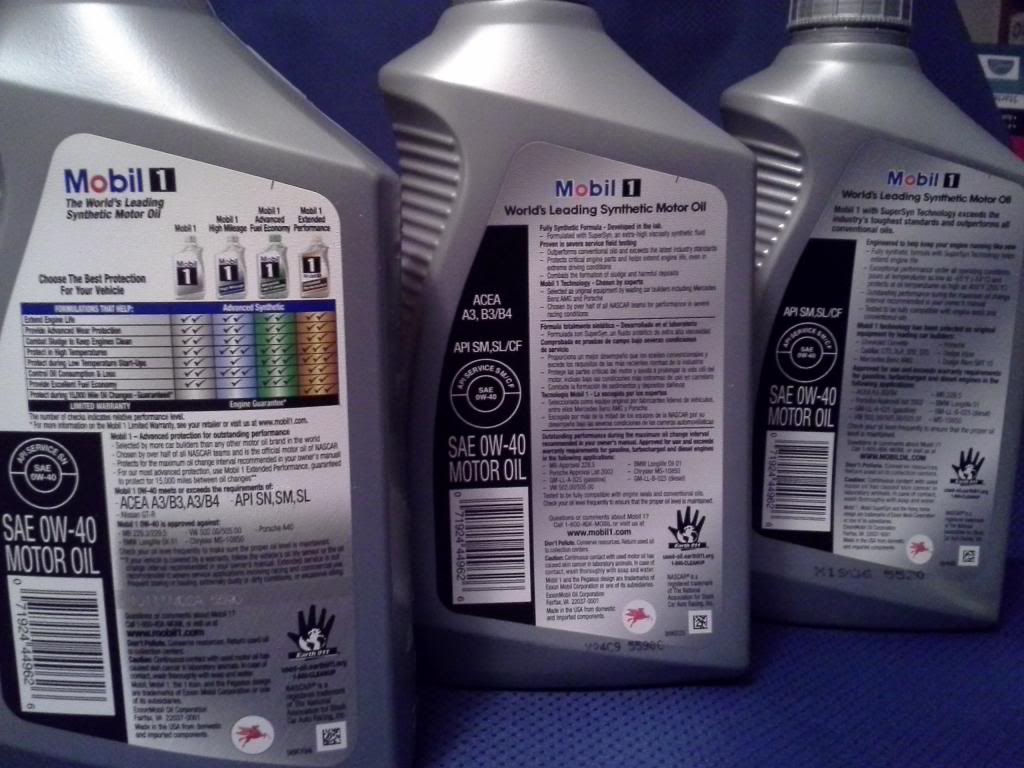
5w20

Sorry, couldn't find a back label of a bottle of Mobil1 5w20 in a GIS.
If I remember, I might take a pic of this bottle at work.
I know I show Mobil products here, but there are many brands that have products that meet Hondas specs.
There are many more that don't.
Here's a document about the new (not really new now) 5w30 HTO-06 spec for the Acura RDX Turbo http://www.google.com/url?sa=i&rct=j&q=&esrc=s&source=images&cd=&cad=rja &uact=8&docid=_sgGYFFcjOAkFM&tbnid=9tsar2nnxFVAxM: &ved=0CAIQjBw&url=http%3A%2F%2Fstatic.flickr.com%2 F31%2F204240935_8e79a2460f_o_d.jpg&ei=zW5LU7myEeGq yAGUsIGYDw&bvm=bv.64542518,d.aWc&psig=AFQjCNHtltnK jcDkzKGzsNrNGwCoj2d9Hw&ust=1397538889473397
Here's a couple of oils that might appear the same at first, but are quite different and only one is approved for recent General Motors DEXOS specification....You pour in the wrong one and you can void your warranty.

Definitely don't use this

LMAO @ "better than it has to be". Taking a whizz in the crankcase might be better than that oil.
One more, don't buy.....it even tells you straight up it doesn't meet newer specs......and it even has a typo on the label

Specs they DON'T meet can be scarily deceptive. Certain manufacturers are known to have deceptive wording on their labels, more than certain others.
0w40
5w20
Sorry, couldn't find a back label of a bottle of Mobil1 5w20 in a GIS.
If I remember, I might take a pic of this bottle at work.
I know I show Mobil products here, but there are many brands that have products that meet Hondas specs.
There are many more that don't.
Here's a document about the new (not really new now) 5w30 HTO-06 spec for the Acura RDX Turbo http://www.google.com/url?sa=i&rct=j&q=&esrc=s&source=images&cd=&cad=rja &uact=8&docid=_sgGYFFcjOAkFM&tbnid=9tsar2nnxFVAxM: &ved=0CAIQjBw&url=http%3A%2F%2Fstatic.flickr.com%2 F31%2F204240935_8e79a2460f_o_d.jpg&ei=zW5LU7myEeGq yAGUsIGYDw&bvm=bv.64542518,d.aWc&psig=AFQjCNHtltnK jcDkzKGzsNrNGwCoj2d9Hw&ust=1397538889473397
Here's a couple of oils that might appear the same at first, but are quite different and only one is approved for recent General Motors DEXOS specification....You pour in the wrong one and you can void your warranty.
Definitely don't use this
LMAO @ "better than it has to be". Taking a whizz in the crankcase might be better than that oil.
One more, don't buy.....it even tells you straight up it doesn't meet newer specs......and it even has a typo on the label
Last edited by ezone; Apr 14, 2014 at 12:38 AM.
Registered!!
Joined: Jul 2009
Posts: 425
Likes: 1
Rep Power: 211 Re: Read before answering please!
I am 110% that that using this oil is your only real problem. I was having similar problems until I change back to Non-high mileage Castrol oil. I figured it out after I found out all high mileage oils contain a hybrid synthetic blend. Honda's don't like synthetic oil. The oil you are burning is the synthetic part of the oil. It will take a couple of oil changes for the problem to completely resolve...
*watches temp gauge like a hawkboss* :D
Joined: Feb 2014
Posts: 610
Likes: 1
From: Definitely older than ezone's skateboard. XD
Rep Power: 0 Re: Read before answering please!
When you read that a high-mileage oil is a 'blend', makes sure you figure out what's being blended. For example my Mobil 1 5W20 HM is a 'proprietary blend of high performance synthetic basestocks fortified with an additive system', not dino oil.
FYI: in Mobil 1 HM, these are the additives:
Extra anti-wear additive
Helps protect critical engine parts in high mileage engines.
Extra cleaning additive
Helps to reduce the sludge and deposits that conventional oils can leave behind.
Seal conditioner
Helps prevent leaks.
Sounds like just what I need in a 144K Civic with nonchalant maintenance (up to now, of course).

It is ACEA A1/B1 and API SL approved, with an API rating of CF.
If you think a good mechanic is expensive, try hiring a bad one
Joined: Dec 2011
Posts: 32,017
Likes: 256
From: Midwest. Aiming about mid-chest
Rep Power: 520 Re: Read before answering please!
Honda sells full synthetic with their own label


We also have blends available.
We also have blends available.
If you think a good mechanic is expensive, try hiring a bad one
Joined: Dec 2011
Posts: 32,017
Likes: 256
From: Midwest. Aiming about mid-chest
Rep Power: 520 Re: Read before answering please!
Hmmmm......I see the BP logo on that bottle.
Isn't that the same BP commpany that downplayed the severity of the "leak" in their Deepwater Horizon well disaster on the bottom of the Gulf of Mexico? And downplayed the severity of the "leak" into Lake Michigan?
Yeah. The same. I'm sure they are totally honest.
Isn't that the same BP commpany that downplayed the severity of the "leak" in their Deepwater Horizon well disaster on the bottom of the Gulf of Mexico? And downplayed the severity of the "leak" into Lake Michigan?
Yeah. The same. I'm sure they are totally honest.
Thread Starter
Registered!!
Joined: Sep 2012
Posts: 215
Likes: 0
Rep Power: 0 Re: Read before answering please!
Hmmmm......I see the BP logo on that bottle.
Isn't that the same BP commpany that downplayed the severity of the "leak" in their Deepwater Horizon well disaster on the bottom of the Gulf of Mexico? And downplayed the severity of the "leak" into Lake Michigan?
Yeah. The same. I'm sure they are totally honest.
Isn't that the same BP commpany that downplayed the severity of the "leak" in their Deepwater Horizon well disaster on the bottom of the Gulf of Mexico? And downplayed the severity of the "leak" into Lake Michigan?
Yeah. The same. I'm sure they are totally honest.
That's what I've been using cause a master mechanic friend of mine runs it in his daughters 02 civic. I don't mind changing though if it mean my car lasts longer. *watches temp gauge like a hawkboss* :D
Joined: Feb 2014
Posts: 610
Likes: 1
From: Definitely older than ezone's skateboard. XD
Rep Power: 0 Re: Read before answering please!
Hmmmm......I see the BP logo on that bottle.
Isn't that the same BP company that downplayed the severity of the "leak" in their Deepwater Horizon well disaster on the bottom of the Gulf of Mexico? And downplayed the severity of the "leak" into Lake Michigan?
Yeah. The same. I'm sure they are totally honest.
Isn't that the same BP company that downplayed the severity of the "leak" in their Deepwater Horizon well disaster on the bottom of the Gulf of Mexico? And downplayed the severity of the "leak" into Lake Michigan?
Yeah. The same. I'm sure they are totally honest.
 He did stop using Castrol, but not until that drum was empty.
 Seriously, though -- their shelf oils are fine... if they were as bad as that, they wouldn't even bother saying it's part-synth, why not yolo it.
 Their incompetence with managing drunk cowboy morons on an oil platform doesn't extend all the way to their subsidiary products, aka shelf oil. Labels go on millions of gallons of product, they wouldn't be THAT stupid to risk the litigation and shelf pulls of it all.
*watches temp gauge like a hawkboss* :D
Joined: Feb 2014
Posts: 610
Likes: 1
From: Definitely older than ezone's skateboard. XD
Rep Power: 0 Re: Read before answering please!
I know. But there are those that don't, comment was for them. Creepwater is still a sore subject for those with good memories...
Wasn't GTX a full-dino oil back when? I used to run my old rat-trap '78 E-150 Chateau on GTX back in the early '90s, and it loved it... well, of course it did, with 160K, a manifold coolant leak, non-functioning vacuum secondaries, a tangle of rocky vacuum lines... and no throttle kickdown -- I had to loosen the doghouse and pull on the rod myself to kickdown -- thank underdeveloped plastic parts in a hellish-hot environment for that mess!
If GTX is part-synth now, that's at least a step up, if still not ideal.
'Master mechanic' btw, is only a sign you've passed a test -- it's no guarantee their advice on such a potential-hairball subject like oils is solid, until you see proof of their reccies through use in their own vehicles. I've met -- and bumped heads with -- a *lot* of hack 'master mechanics', who can't tell me basic stuff like stoichiometric ratio, what three things are all required to occur together to run an IC engine, or why power and torque traces on a dyno pull cross at 5252 rpm -- much of them only know a narrow range of hands-on knowledge on a single brand, some only on one vehicle. One MM tried to tell me back in my junior tech days, there was no such thing as synthetic oil, that it was a gimmick to sell you filtered waste product from the oil production process at a premium. Prolly was just hazing me... but if he wasn't, that's no master of mechanics. 
But there are those that don't, comment was for them. Creepwater is still a sore subject for those with good memories...Wasn't GTX a full-dino oil back when? I used to run my old rat-trap '78 E-150 Chateau on GTX back in the early '90s, and it loved it... well, of course it did, with 160K, a manifold coolant leak, non-functioning vacuum secondaries, a tangle of rocky vacuum lines... and no throttle kickdown -- I had to loosen the doghouse and pull on the rod myself to kickdown -- thank underdeveloped plastic parts in a hellish-hot environment for that mess!
If GTX is part-synth now, that's at least a step up, if still not ideal.
'Master mechanic' btw, is only a sign you've passed a test -- it's no guarantee their advice on such a potential-hairball subject like oils
is solid, until you see proof of their reccies through use in their own vehicles. I've met -- and bumped heads with -- a *lot* of hack 'master mechanics', who can't tell me basic stuff like stoichiometric ratio, what three things are all required to occur together to run an IC engine, or why power and torque traces on a dyno pull cross at 5252 rpm -- much of them only know a narrow range of hands-on knowledge on a single brand, some only on one vehicle. One MM tried to tell me back in my junior tech days, there was no such thing as synthetic oil, that it was a gimmick to sell you filtered waste product from the oil production process at a premium. Prolly was just hazing me... but if he wasn't, that's no master of mechanics. If you think a good mechanic is expensive, try hiring a bad one
Joined: Dec 2011
Posts: 32,017
Likes: 256
From: Midwest. Aiming about mid-chest
Rep Power: 520 Re: Read before answering please!
The same masters that can't operate a test light or voltmeter?
1963 VW Bug with the ol Baja kit on it. Damn hard to start when it was full of 20w50 in the dead of winter. Went through 3 engines and transmissions in about 3 years LOL.
Wasn't GTX .. oil back when? ....'78 E-150
Thread Starter
Registered!!
Joined: Sep 2012
Posts: 215
Likes: 0
Rep Power: 0 Re: Read before answering please!
He's a good mechanic, but his knowledge is...old. He was in highschool when everyone was putting pozzy track rear ends in their muscle cars(early 60's). He is smart, but I don't always go with what he says.

