


HID + rain = suck


Thread Starter
Joined: Sep 2002
Posts: 51,241
Likes: 20
From: NV
Rep Power: 813 

HID + rain = suck
Well I thought getting these would help me see in bad weather, but boy was I wrong. Still can't see very well. I guess stock yellowish really is the best. The HID is still nice in good weather.


Registered!!
iTrader: (20)
Joined: Sep 2002
Posts: 4,111
Likes: 1
From: Cleveland, OH
Rep Power: 331 the debate about white vs. yellow continues... personally i think white is better than yellow, but the angle of the lights is most important. any fogs will help you in rain more because they are angled down and not reflecting right in your face.
but with yellow fogs you won't be unusual. lexus had 'em.
but with yellow fogs you won't be unusual. lexus had 'em.


Civicforums Junkie
iTrader: (55)
Joined: Oct 2002
Posts: 16,087
Likes: 0
From: ARIZONA
Rep Power: 450
Originally Posted by gearbox
some people have put yellow tint film on em. Then you'll see even better.


Joined: Dec 2003
Posts: 4,773
Likes: 0
From: IL
Rep Power: 321 
I got em stock, they have a switch by the cig plug, and when its on they turn on w/ headlights, i wanna re-wire so they turn on w/ parking but im too lazy to figure it out and start takin things apart 
Joined: Dec 2003
Posts: 4,773
Likes: 0
From: IL
Rep Power: 321 my friend re did his fogs to the parking lights im pretty sure he said it was some wire behind his switch.. (this was on a probe tho) hmmm that'd be cool if i could re-wire the switch to turn em on/off so i could have em on w/o parking or headlights..

Registered!!
Joined: Jun 2003
Posts: 209
Likes: 0
From: NOVA
Rep Power: 0 Wow, I can't believe the misconception of blasphemous HID bashing going on here...
What kind of HIDs do you have that you are getting less visibility in the rain?
for reference:
4100k HIDs = 3200 lumens
5000k HIDs = 3000 lumens
6500k HIDs = 2500 lumens
8000k+ HIDs = <2000 lumens
Stock Halogens = 1000 lumens @ 3300k
The "color" of HIDs is insignificant in comparison to the color rendering index of HIDs. The problem is that unless you have a quality Phillips or Osram bulb you are probably trading off color (aka high color temperature 6000k+) for a good CRI.
CRI is color rendering index. basically just is it giving out all the same colors that the sun gives out in equal proportion so that your eyes can make a good reference. ALL halogen objects i.e. SUN, your stock incandescent/halogen bulbs have a 100% CRI. HIDs and florescents because they are igniting a salt which burns with different combinations of spectral energy can vary between very poor street lamps at 50% CRI and good HID bulbs which easily exceed 99% CRI.
OEM 4100k and 5000k phillips or osram bulbs will give you the correct CRI and will provide equal standing in this measure.
As far as brightness, if you are using an OEM 4100k or 5000k bulb you are getting roughly 3 times the amount of lumens to the road compared to the stock halogen bulbs. There is no way halogen wins here.
The only other consideration is whether the bulb has the same focal place that the OEM halogen bulb has. As you know "kits" are illegal because the focal point changes so drastically from kit to kit.
Halogen reflectors != HID reflectors
Simply put, if you're getting a crappy beam pattern because of your halogen reflector based HID plug and play kit; don't blame HIDs, blame your stock reflectors.
HID Projectors are 100x better in dispersion than Anything else I know of, and I've had everything. IT really makes a night and day difference between stock halogens -> HID Kit -> HID projectors.
I've done 3 retrofits with BMW/Audi/Acura Projectors, and owned a catz kit, and put a plug and play HID kit in my wife's car. Don't hate on the HIDs, they're 3x more efficient and use half the electricity of halogens. Unlike Halogens or incandescents they can produce a myriad of color rendering Index and color temperatures. The sky is the limit.
HIDs are like plastic, you can make cheap crap out of them; but just because you can, doesn't mean that you can't make wonderful things out of them also. Please be responsible, use HIDs with caution :-p
What kind of HIDs do you have that you are getting less visibility in the rain?
for reference:
4100k HIDs = 3200 lumens
5000k HIDs = 3000 lumens
6500k HIDs = 2500 lumens
8000k+ HIDs = <2000 lumens
Stock Halogens = 1000 lumens @ 3300k
The "color" of HIDs is insignificant in comparison to the color rendering index of HIDs. The problem is that unless you have a quality Phillips or Osram bulb you are probably trading off color (aka high color temperature 6000k+) for a good CRI.
CRI is color rendering index. basically just is it giving out all the same colors that the sun gives out in equal proportion so that your eyes can make a good reference. ALL halogen objects i.e. SUN, your stock incandescent/halogen bulbs have a 100% CRI. HIDs and florescents because they are igniting a salt which burns with different combinations of spectral energy can vary between very poor street lamps at 50% CRI and good HID bulbs which easily exceed 99% CRI.
OEM 4100k and 5000k phillips or osram bulbs will give you the correct CRI and will provide equal standing in this measure.
As far as brightness, if you are using an OEM 4100k or 5000k bulb you are getting roughly 3 times the amount of lumens to the road compared to the stock halogen bulbs. There is no way halogen wins here.
The only other consideration is whether the bulb has the same focal place that the OEM halogen bulb has. As you know "kits" are illegal because the focal point changes so drastically from kit to kit.
Halogen reflectors != HID reflectors
Simply put, if you're getting a crappy beam pattern because of your halogen reflector based HID plug and play kit; don't blame HIDs, blame your stock reflectors.
HID Projectors are 100x better in dispersion than Anything else I know of, and I've had everything. IT really makes a night and day difference between stock halogens -> HID Kit -> HID projectors.
I've done 3 retrofits with BMW/Audi/Acura Projectors, and owned a catz kit, and put a plug and play HID kit in my wife's car. Don't hate on the HIDs, they're 3x more efficient and use half the electricity of halogens. Unlike Halogens or incandescents they can produce a myriad of color rendering Index and color temperatures. The sky is the limit.
HIDs are like plastic, you can make cheap crap out of them; but just because you can, doesn't mean that you can't make wonderful things out of them also. Please be responsible, use HIDs with caution :-p
Registered!!
Joined: Jun 2003
Posts: 209
Likes: 0
From: NOVA
Rep Power: 0 IF you all aren't happy with your HIDs, hit me up on AIM or PMs, maybe I can help you figure out the issue. Maybe just a little bit of tweaking, or swapping out a different bulb would help. I can help you figure out what's wrong. You should be loving your HIDs!!!
Registered!!
Joined: Jun 2003
Posts: 209
Likes: 0
From: NOVA
Rep Power: 0 I was thinking more about people's posts...
Yellow light absolutely does not help you see better in the rain. Flat out, no.
The confusion lies in that people notice that halogens with 100% CRI are more yellowish than cheap blue bulb HIDs with poor a CRI rating, so some where people get the idea that yellow will help them see better. Maybe if your blue bulb HID kit is lacking in the yellow range by adding yellow light you might come to a better CRI, but we're now just masking the problem. Plus Fog lights are not meant to equalize or help you see better at all, their range is so short that their impact is minimal when used with a HID bulb which will overpower all Halogen Fog lights. Their range is soley meant for foreground and side lighting which is useful in the FOG only, not meant for regular driving. If you really wanted some more useful normal lighting in ALL conditions, an auxilary beam light would be your best bet. They sell a HID auxiliary light on the Osram website for like 250$ and they're really sweet. They only come in 4100k.
If HIDs hindered viewing in the rain, we would not see them on all the luxury vehicles. There is a reason ONLY 4100k bulbs come from the factory. You can get 5000k "color matching" bulbs which are supposed to imitate an older 4100k bulb, but they look pretty much the same. The Phillips Ultinon at 6500k is never sold OEM on a car. They have a good CRI, but are down to 2000 lumens or something like that, and cost 250$ a pair compared with 70$ 4100k bulbs. Any other no-name HID bulb IMO is suspect because they trade off color for CRI and that's when we start getting these complaints about them not being good in the rain, and that's complete bunk.
A good bulb has a high CRI, high output, long life, and a small color shift over it's life.
Color is only for show.
Any bulb with tinting will lower the CRI and lower your ability to see better.
Blue bulb + yellow Bulb = slightly better than either alone.
Good Bulb with High CRI in the first place = best
Hope that helps clear up a little confusion
Yellow light absolutely does not help you see better in the rain. Flat out, no.
The confusion lies in that people notice that halogens with 100% CRI are more yellowish than cheap blue bulb HIDs with poor a CRI rating, so some where people get the idea that yellow will help them see better. Maybe if your blue bulb HID kit is lacking in the yellow range by adding yellow light you might come to a better CRI, but we're now just masking the problem. Plus Fog lights are not meant to equalize or help you see better at all, their range is so short that their impact is minimal when used with a HID bulb which will overpower all Halogen Fog lights. Their range is soley meant for foreground and side lighting which is useful in the FOG only, not meant for regular driving. If you really wanted some more useful normal lighting in ALL conditions, an auxilary beam light would be your best bet. They sell a HID auxiliary light on the Osram website for like 250$ and they're really sweet. They only come in 4100k.
If HIDs hindered viewing in the rain, we would not see them on all the luxury vehicles. There is a reason ONLY 4100k bulbs come from the factory. You can get 5000k "color matching" bulbs which are supposed to imitate an older 4100k bulb, but they look pretty much the same. The Phillips Ultinon at 6500k is never sold OEM on a car. They have a good CRI, but are down to 2000 lumens or something like that, and cost 250$ a pair compared with 70$ 4100k bulbs. Any other no-name HID bulb IMO is suspect because they trade off color for CRI and that's when we start getting these complaints about them not being good in the rain, and that's complete bunk.
A good bulb has a high CRI, high output, long life, and a small color shift over it's life.
Color is only for show.
Any bulb with tinting will lower the CRI and lower your ability to see better.
Blue bulb + yellow Bulb = slightly better than either alone.
Good Bulb with High CRI in the first place = best
Hope that helps clear up a little confusion
Last edited by Ocelaris; Jan 25, 2005 at 06:33 AM.
Thread Starter
Joined: Sep 2002
Posts: 51,241
Likes: 20
From: NV
Rep Power: 813 Thanks, but I hve to disagree with one thing. It has already been proven that the human eye can discern objects better at night under natural, yellowish light. It's an established fact and this is why they make so called weather vision halogen bulbs (by philips) that are lower in the light color spectrum to aid vision in areas with constant rain or snow. Why do you think all the streetlights are that orange/yellow color? You can see alot more objects around you when compared to those new white ones they have some places.
I think I mentioned this already, but I have the catz hit kit 4300k which is oem on some cars in Japan. The light focal point is designed to be exactly the same as the halogens that were in there (and it is). Not really any glare, and a nice cutoff on the wall. Don't get me wrong, they are very bright compared to halogen, however that doesn't mean my eyes can see better with them. When I had my coated halogen bulbs to emit whiter light, they were still within the legal lumens but I couldn't see anything unless it was perfect weather. In rain it looked like they were off. So what I'm saying is hid is just a brighter form of that white light, but not any better than the stock halogens.
Okay this makes me realize that maybe having the hid in halogen housing is not focusing the light as much as projectors would. Even tho halogen housings make them brighter than they should be. Don't get me wrong, I like my hids alot, just sometimes on those rainy days I wish I had that yellow 3200k light to see better.
I think I mentioned this already, but I have the catz hit kit 4300k which is oem on some cars in Japan. The light focal point is designed to be exactly the same as the halogens that were in there (and it is). Not really any glare, and a nice cutoff on the wall. Don't get me wrong, they are very bright compared to halogen, however that doesn't mean my eyes can see better with them. When I had my coated halogen bulbs to emit whiter light, they were still within the legal lumens but I couldn't see anything unless it was perfect weather. In rain it looked like they were off. So what I'm saying is hid is just a brighter form of that white light, but not any better than the stock halogens.
Okay this makes me realize that maybe having the hid in halogen housing is not focusing the light as much as projectors would. Even tho halogen housings make them brighter than they should be. Don't get me wrong, I like my hids alot, just sometimes on those rainy days I wish I had that yellow 3200k light to see better.
Last edited by gearbox; Jan 25, 2005 at 08:30 AM.
Registered!!
Joined: Jun 2003
Posts: 209
Likes: 0
From: NOVA
Rep Power: 0 Lets define "see" because sensitivity to a color and ability to focus on a color are two different things.
The human eye does not focus on blue light very well, that is true, but 4100k (HID) is not a blue bulb by any means.
The reason street lights are orange/yellow has nothing to do with benefits of your vision whats so ever... The Street lights that you are referring to are called High Pressure Sodium (HPS) and are use SOLEY on the purpose of efficiency. HPS gets around 200 lumens per watt efficiency, HIDs which cars and some "white" street lights use are called Metal Halide and get around 100 lumens per watt. Halogens by comparison get 20 lumens per watt. The trade off of efficiency is color rendering index and color temperature. The CRI of HPS bulbs is around 50% which makes them horrible for vision, you can't differentiate between a fox and a child running across the road. In europe they use Low Pressure Sodium because it reaps 220 lumens per watts, but it has 0% CRI meaning monochromatic.
"Painstaking experiments have yielded response curves for three different kind of cones in the retina of the human eye. The "green" and "red" cones are mostly packed into the fovea centralis. By population, about 64% of the cones are red-sensitive, about 32% green sensitive, and about 2% are blue sensitive. The "blue" cones have the highest sensitivity and are mostly found outside the fovea. The shapes of the curves are obtained by measurement of the absorption by the cones, but the relative heights for the three types are set equal for lack of detailed data. There are fewer blue cones, but the blue sensitivity is comparable to the others, so there must be some boosting mechanism. In the final visual perception, the three types seem to be comparable, but the detailed process of achieving this is not known. "
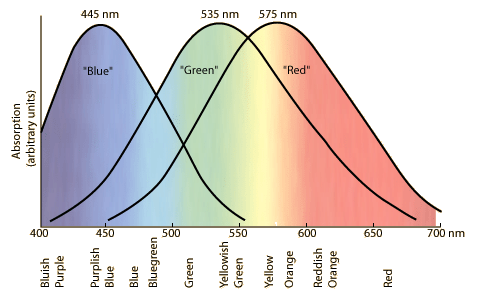
http://hyperphysics.phy-astr.gsu.edu...colcon.html#c1
Basically what they're saying is that you can not focus well because the blue cones are outside the area where we focus on precision matter... So red and green light would be more suitable, but red being the best.
You're right, reddish light would be the best for "focusing" quickly and adeptly.
I'm not gonna knock catz. But I am gonna tell you that the story of them being an OEM manufacturer for some companies in Japan is BS. Sorry, Osram and phillips are the ONLY bulb manufacturers in the world for OEM. And Hella, Matsushita (panasonic), Bosch, Litronic, Valeo, and Mitsubishi count in the OEM ballast manufacturer's circle. With Matsushita and Mitsubishi being the ONLY JDM HID ballast manufacturers.
I've owned a catz kit, and it was flat out dangerous to me... and I never drove in the rain with them, only had them a week and sold them. You're right about the glare and cutoff, but the pattern on the ground was what was so bad, it was a very short distance is what I noticed. I kept feeling like things sprang up on me.
My wife's car has crappier reflectors, and Phillips 5k bulbs, and it's much better, why? I don't know specifically, but I'm guessing because they're better bulbs with higher CRI.
I understand what you're talking about, but blame your bulbs. HIDs with a proper color balance will give you better lighting in the rain than halogens.
"Natural Yellowish" is an oxymoron. The color temperature throughout the day and throughout the planet changes over the course of the day. it may start at 2000k at morning with red, and by the end of the day it will be at 10,000k
Normal Natural Daylight at noon is around 5500k with 100% CRI in the northern latittudes. At the equator the color temp is 10,000k ! I'm serious, there is nowhere that full sun is 4100k except as it rises and falls. 4100k by reference to HIDs is more than enough yellow, it's considered a "warm white" in florescent tubes. Cool white in florescents is 6000k+.
And this is all just semantics because I could never find a color spectrum chart of HID bulbs... or at least the automotive kind. for aquariums you could find them for the bulb quite easily and it would prove that there is enough red... sorry I don't have a good diagram for that... but check out my most respected HID bulb company Iwasaki
http://www.eye.co.jp/product/kougen.html
they have 4 Metal Halide bulbs there, their 6500k bulb is the one I have personally used. it reads "Excellent Color Rendering, Close to that of Natural Sunlight" Their 4500k bulb reads "Very High in the Red Spectrum" it sorta requires having the japanese fonts installed, I jsut escaped and i could read some, it has a chart there for color...
http://www.handprint.com/HP/WCL/wcolor.html <- some color vision link
Automotive color temperatures have bastardized the entire meaning of the word. In better regulated hobbies like aquariums or grow lights the actual temperature ratings have meaning because they are paired with a CRI.
I'm out of breath and way past rambling. I think we basically agree... you're right, red/orange is better for seeing, but my point is that 4100k is more than red enough. You can believe me or not, I have quite a bit of experience and knowledge; but I guess it's a personal decision.
The human eye does not focus on blue light very well, that is true, but 4100k (HID) is not a blue bulb by any means.
The reason street lights are orange/yellow has nothing to do with benefits of your vision whats so ever... The Street lights that you are referring to are called High Pressure Sodium (HPS) and are use SOLEY on the purpose of efficiency. HPS gets around 200 lumens per watt efficiency, HIDs which cars and some "white" street lights use are called Metal Halide and get around 100 lumens per watt. Halogens by comparison get 20 lumens per watt. The trade off of efficiency is color rendering index and color temperature. The CRI of HPS bulbs is around 50% which makes them horrible for vision, you can't differentiate between a fox and a child running across the road. In europe they use Low Pressure Sodium because it reaps 220 lumens per watts, but it has 0% CRI meaning monochromatic.
"Painstaking experiments have yielded response curves for three different kind of cones in the retina of the human eye. The "green" and "red" cones are mostly packed into the fovea centralis. By population, about 64% of the cones are red-sensitive, about 32% green sensitive, and about 2% are blue sensitive. The "blue" cones have the highest sensitivity and are mostly found outside the fovea. The shapes of the curves are obtained by measurement of the absorption by the cones, but the relative heights for the three types are set equal for lack of detailed data. There are fewer blue cones, but the blue sensitivity is comparable to the others, so there must be some boosting mechanism. In the final visual perception, the three types seem to be comparable, but the detailed process of achieving this is not known. "
http://hyperphysics.phy-astr.gsu.edu...colcon.html#c1
Basically what they're saying is that you can not focus well because the blue cones are outside the area where we focus on precision matter... So red and green light would be more suitable, but red being the best.
You're right, reddish light would be the best for "focusing" quickly and adeptly.
I'm not gonna knock catz. But I am gonna tell you that the story of them being an OEM manufacturer for some companies in Japan is BS. Sorry, Osram and phillips are the ONLY bulb manufacturers in the world for OEM. And Hella, Matsushita (panasonic), Bosch, Litronic, Valeo, and Mitsubishi count in the OEM ballast manufacturer's circle. With Matsushita and Mitsubishi being the ONLY JDM HID ballast manufacturers.
I've owned a catz kit, and it was flat out dangerous to me... and I never drove in the rain with them, only had them a week and sold them. You're right about the glare and cutoff, but the pattern on the ground was what was so bad, it was a very short distance is what I noticed. I kept feeling like things sprang up on me.
My wife's car has crappier reflectors, and Phillips 5k bulbs, and it's much better, why? I don't know specifically, but I'm guessing because they're better bulbs with higher CRI.
I understand what you're talking about, but blame your bulbs. HIDs with a proper color balance will give you better lighting in the rain than halogens.
"Natural Yellowish" is an oxymoron. The color temperature throughout the day and throughout the planet changes over the course of the day. it may start at 2000k at morning with red, and by the end of the day it will be at 10,000k
Normal Natural Daylight at noon is around 5500k with 100% CRI in the northern latittudes. At the equator the color temp is 10,000k ! I'm serious, there is nowhere that full sun is 4100k except as it rises and falls. 4100k by reference to HIDs is more than enough yellow, it's considered a "warm white" in florescent tubes. Cool white in florescents is 6000k+.
And this is all just semantics because I could never find a color spectrum chart of HID bulbs... or at least the automotive kind. for aquariums you could find them for the bulb quite easily and it would prove that there is enough red... sorry I don't have a good diagram for that... but check out my most respected HID bulb company Iwasaki
http://www.eye.co.jp/product/kougen.html
they have 4 Metal Halide bulbs there, their 6500k bulb is the one I have personally used. it reads "Excellent Color Rendering, Close to that of Natural Sunlight" Their 4500k bulb reads "Very High in the Red Spectrum" it sorta requires having the japanese fonts installed, I jsut escaped and i could read some, it has a chart there for color...
http://www.handprint.com/HP/WCL/wcolor.html <- some color vision link
Automotive color temperatures have bastardized the entire meaning of the word. In better regulated hobbies like aquariums or grow lights the actual temperature ratings have meaning because they are paired with a CRI.
I'm out of breath and way past rambling. I think we basically agree... you're right, red/orange is better for seeing, but my point is that 4100k is more than red enough. You can believe me or not, I have quite a bit of experience and knowledge; but I guess it's a personal decision.
Registered!!
Joined: Jun 2003
Posts: 209
Likes: 0
From: NOVA
Rep Power: 0 whoo you're a doozy to tango with... anyways, don't forget all HID bulbs color shift to blue over time, so after 100 hours they're all going to be bluer than when the start. The more quality the bulb, the less the color shift will be aparent over time. That's the cost/price of a good bulb.
the catz kit I had were 5k, blue coated... yours could be rebased phillips/osram, who knows. The catz kit I had I could only complain that they didn't have a seperate harness and that the bulb was blue tinted... the ballasts looked like old litronic/bosh ballasts to me...
the catz kit I had were 5k, blue coated... yours could be rebased phillips/osram, who knows. The catz kit I had I could only complain that they didn't have a seperate harness and that the bulb was blue tinted... the ballasts looked like old litronic/bosh ballasts to me...
Thread Starter
Joined: Sep 2002
Posts: 51,241
Likes: 20
From: NV
Rep Power: 813 Interesting I didn't know that. I also heard that they get dimmer over time instead of burning out? Anyway thanks for the previous info.

Banned
iTrader: (32)
Joined: Mar 2003
Posts: 8,407
Likes: 0
From: Long Island, New York
Rep Power: 0 

Originally Posted by gearbox
I also heard that they get dimmer over time instead of burning out?
I bought new philips 4300k bulbs and too me they were sOooooo YELLOW, and I just couldnt see how they were brighter than 5000k bulbs...
Your eyes think the white is brighter but, it just isnt

Registered!!
Joined: Jun 2003
Posts: 209
Likes: 0
From: NOVA
Rep Power: 0 Yeah, they get dimmer and bluer as time goes by, at about 2000 hours they reccomend the bulbs be switched out. The life span of an HID bulb (i.e. extinguishing it's self) is much greater than the useful luminous capacity. i.e it's something once the bulb has reached 75% or 50% or whatever % of it's original output at 0 hours, it's considered "done" for example... I had 175w Metal halide 10k bulbs over my aquarium for 4 years... the reccomended life span of those was 1 year... to my knowledge my friend has them and they're still running going on 6 years. I've also had bulbs that only last a few months.
I think as long as somebody gets to this post I'll be satisfied... I just didn't want somebody coming in who knew nothing about HIDs and reading "what HIDs suck in the rain"... I mean what ever our respective differences are, I want to stem off simple misconceptions that are actually a more complicated matter.
99% of the time I am ranting against blue, this time I find myself on the other side, ironic dontcha think? damn you allanis moressette...
I think as long as somebody gets to this post I'll be satisfied... I just didn't want somebody coming in who knew nothing about HIDs and reading "what HIDs suck in the rain"... I mean what ever our respective differences are, I want to stem off simple misconceptions that are actually a more complicated matter.
99% of the time I am ranting against blue, this time I find myself on the other side, ironic dontcha think? damn you allanis moressette...
Thread Starter
Joined: Sep 2002
Posts: 51,241
Likes: 20
From: NV
Rep Power: 813 lol, so I guess the only way to really get brighter light is a retrofit in projectors. Hmm so the bulb light will get bluer over time? I guess mine aren't old enough yet. Oh and what about those higher color temp kits? I've seen some pure blue hid in a bmw drive next to mine and totally outshine my white hids on the ground.
Registered!!
Joined: Jun 2003
Posts: 209
Likes: 0
From: NOVA
Rep Power: 0 as color temperature goes up, lumenous efficiency goes down.
A projector does a better job of dispensing the light evenly than a reflector in most cases.
OEM BMWs have a projectors which have a flare which gives them a "shimmer"

that blue streak is the "shimmer" or blue you see...
these are what my "Audi" headlights looked like... they look crazy blue...

but it's only at a certain angle, they're actually 4100k bulbs. In the picture below you can see the low beam HID and high beam Halogen. The bulb on the left is a HID 4100k bulb, the bulb on the right is a Halogen 65watt bulb... In my opinion the color difference is not that great... You can see why.

The reason the BMW outshines you is because they have an expensive HID projector which definetly outshines a halogen reflector based plug and play kit, even if they use the same bulbs.
This is the Projector pattern of a TL, notice how clean and evenly distributed the light is, it focuses at the center where there is the DOT flare, but it spreads out as it goes downwards...

The picture below is actually a halogen H3 projector, I couldn't find a good fair shot of a halogen reflector based HID pic, so here is what I believe is HIDs in a Halogen system...

Dimmer equal light spread out is much better than one bright spot... if you've ever stared at like a magnifying glass focusing the sun's light into one bright spot, it washes out everything else as your iris closes up to balance the light coming into the eye... but everything else becomes dark in response...
A projector does a better job of dispensing the light evenly than a reflector in most cases.
OEM BMWs have a projectors which have a flare which gives them a "shimmer"
that blue streak is the "shimmer" or blue you see...
these are what my "Audi" headlights looked like... they look crazy blue...
but it's only at a certain angle, they're actually 4100k bulbs. In the picture below you can see the low beam HID and high beam Halogen. The bulb on the left is a HID 4100k bulb, the bulb on the right is a Halogen 65watt bulb... In my opinion the color difference is not that great... You can see why.
The reason the BMW outshines you is because they have an expensive HID projector which definetly outshines a halogen reflector based plug and play kit, even if they use the same bulbs.
This is the Projector pattern of a TL, notice how clean and evenly distributed the light is, it focuses at the center where there is the DOT flare, but it spreads out as it goes downwards...
The picture below is actually a halogen H3 projector, I couldn't find a good fair shot of a halogen reflector based HID pic, so here is what I believe is HIDs in a Halogen system...
Dimmer equal light spread out is much better than one bright spot... if you've ever stared at like a magnifying glass focusing the sun's light into one bright spot, it washes out everything else as your iris closes up to balance the light coming into the eye... but everything else becomes dark in response...
Last edited by Ocelaris; Jan 25, 2005 at 11:38 PM.

Thread
Thread Starter
Honda Civic Forum
Replies
Last Post
jdawgzcivic
Engine
17
Feb 1, 2020 04:16 PM
Raiool
Fuel, Oil, Cleaners & Other Maintenance
3
Oct 1, 2015 10:42 AM
TheRiddicles
Suspension Performance Modifications
0
Sep 21, 2015 01:28 AM


